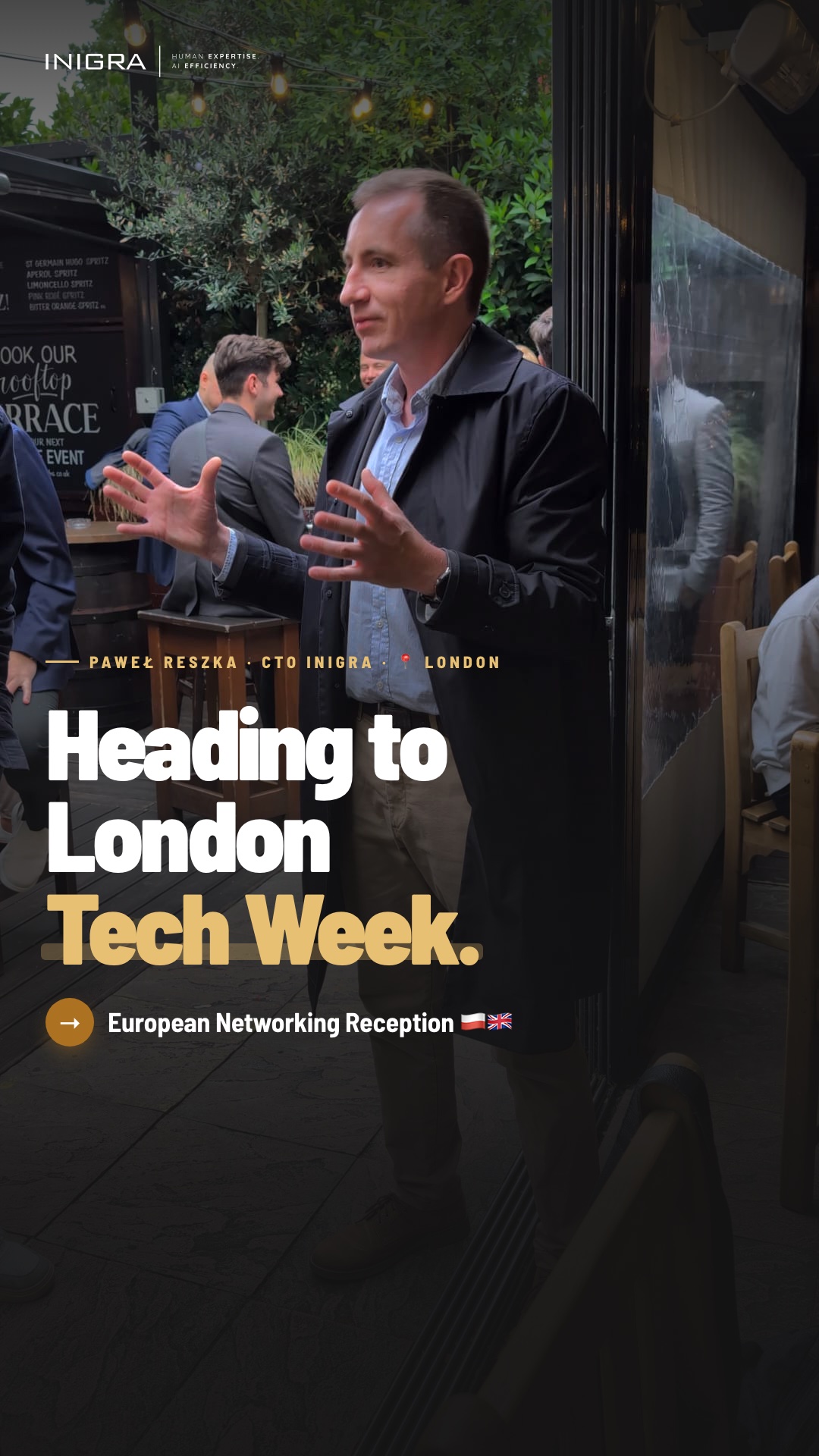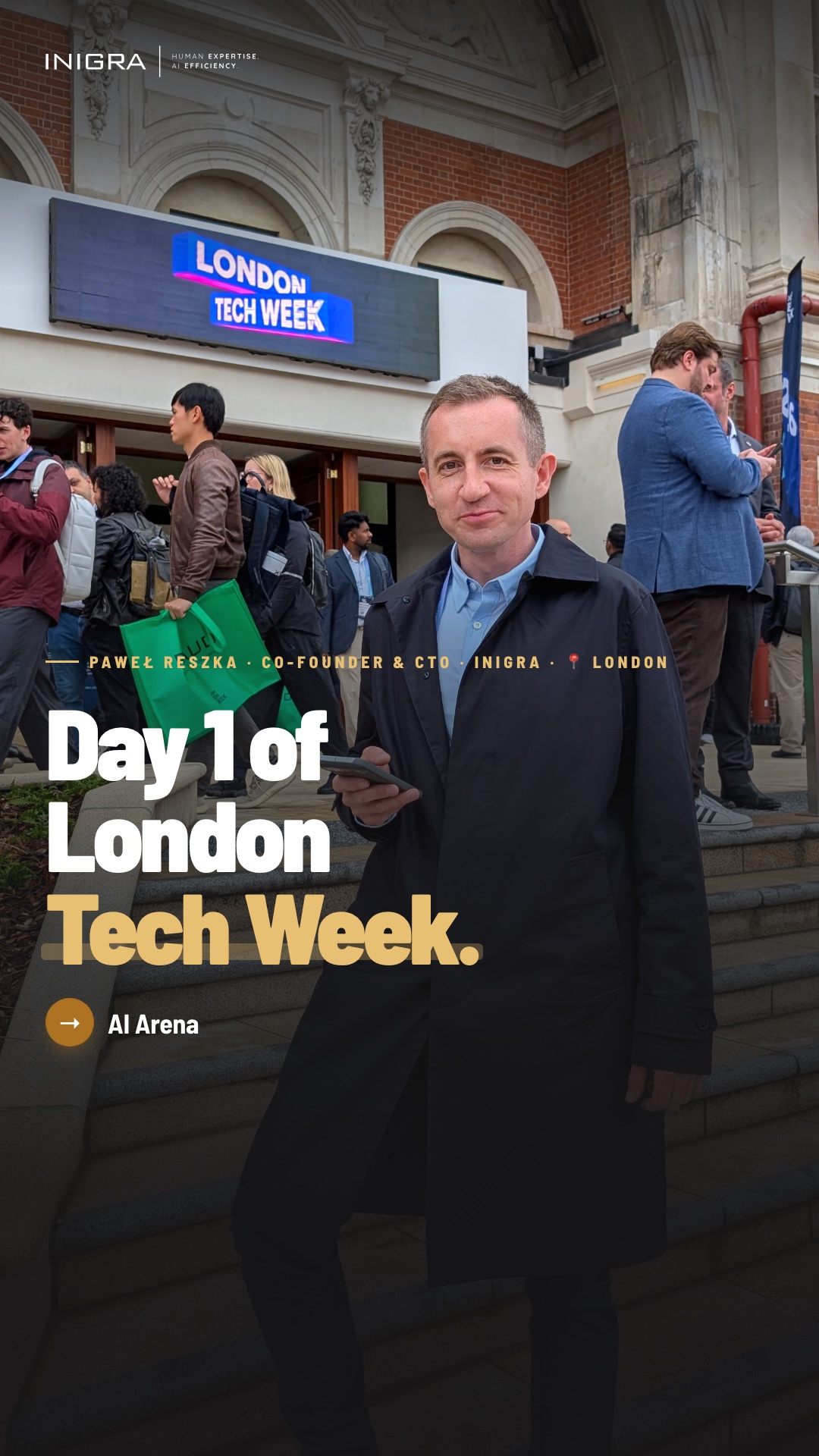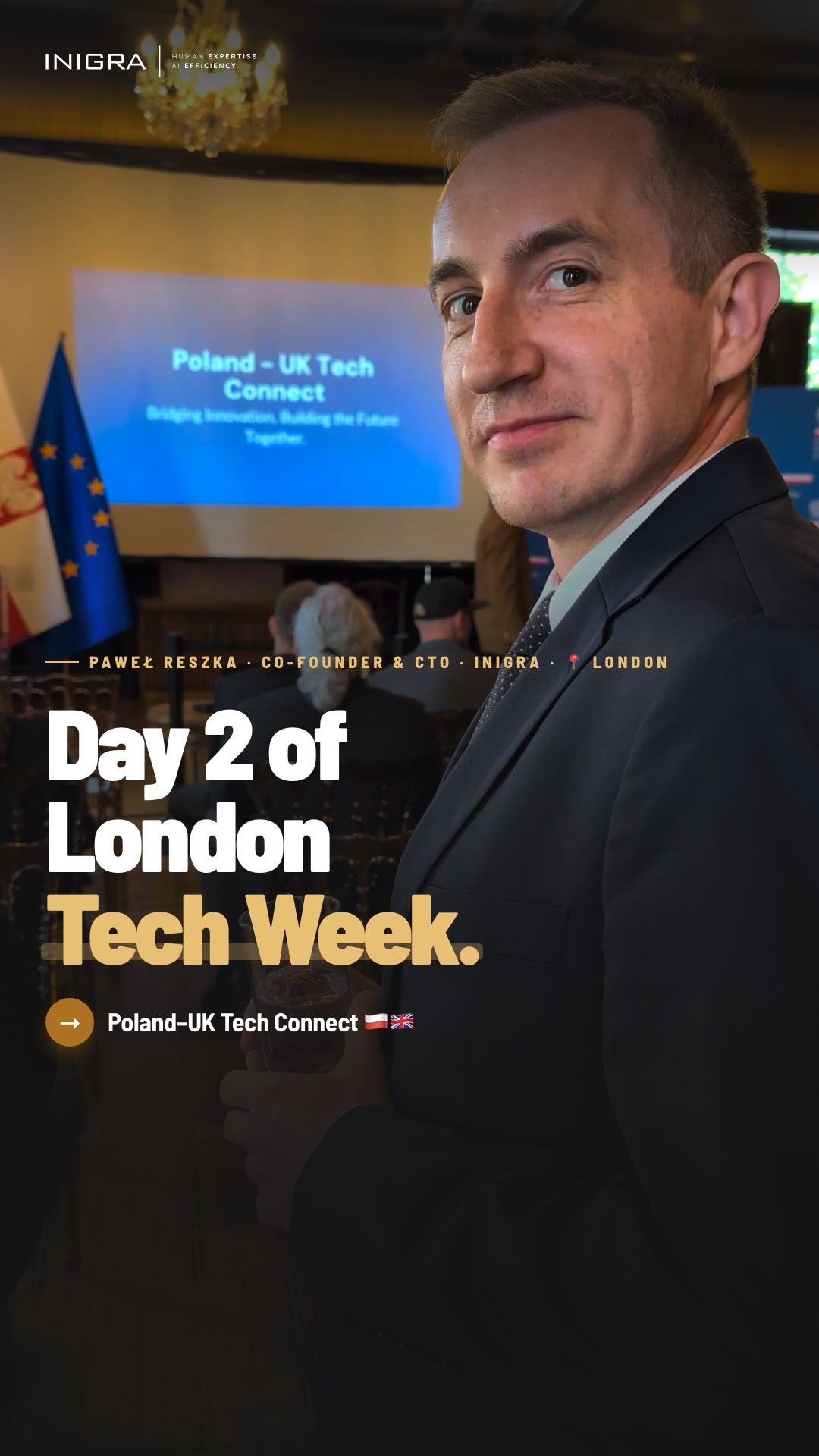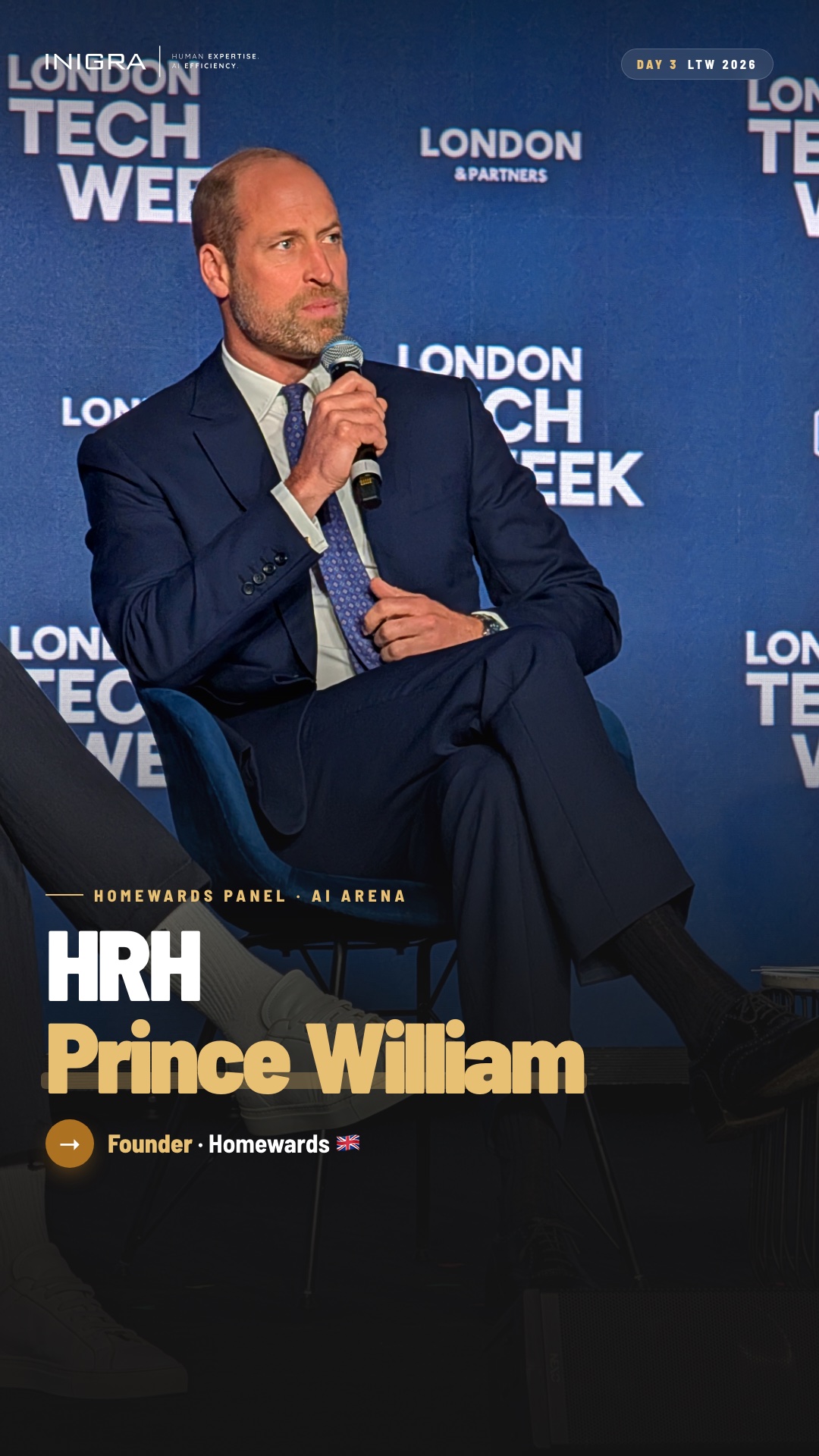
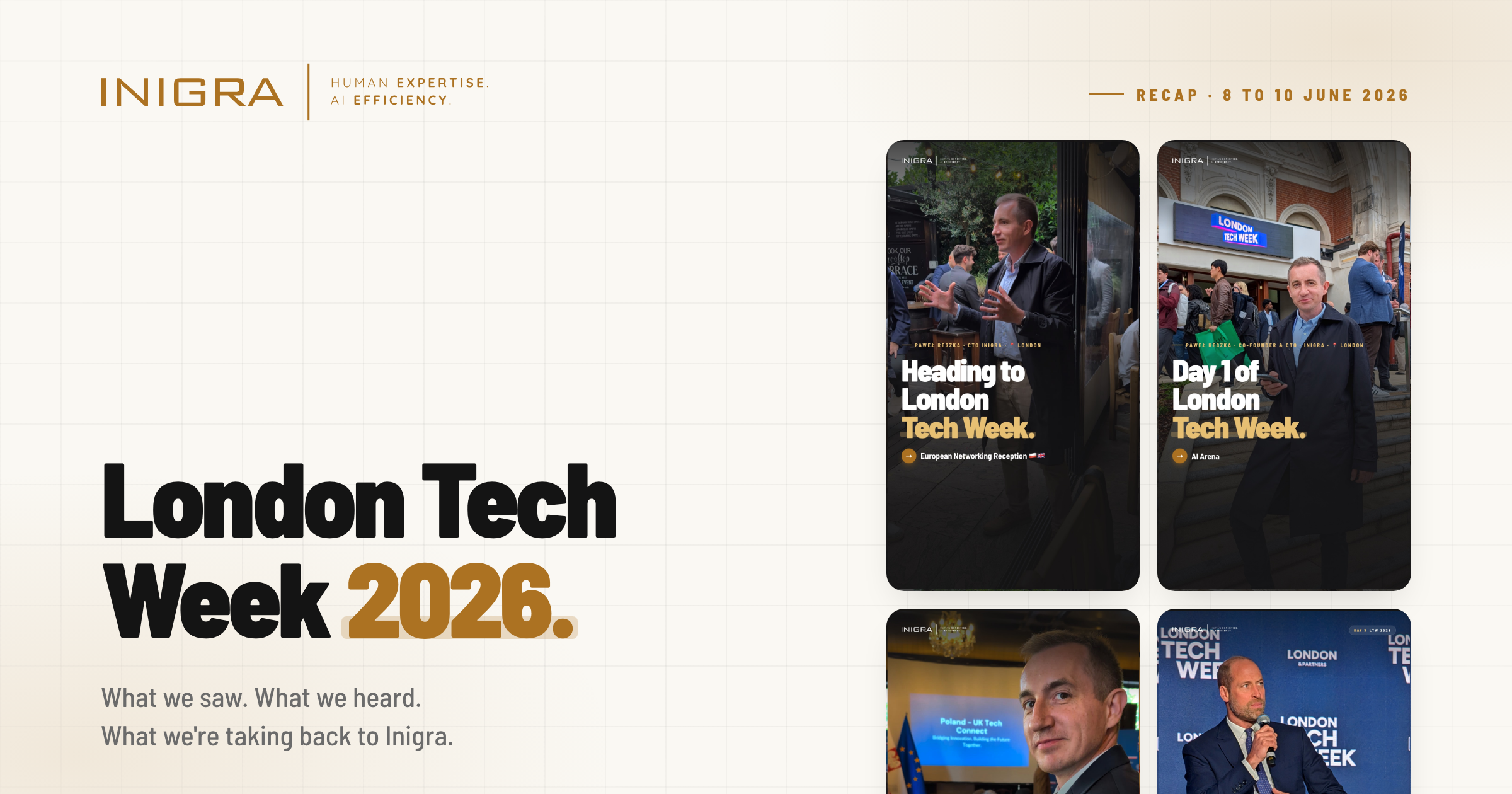
Three days at London Tech Week 2026. The Rt Hon Sir Keir Starmer opened the week. AI Arena hosted Aravind Srinivas (Perplexity), Mati Staniszewski (ElevenLabs), Fabian Hedin (Lovable). The Polish Embassy hosted Poland-UK Tech Connect on Tuesday evening. Day 3 closed with HRH Prince William on the Homewards panel. Below, what we saw, who was in the room, and four short reels filmed on the ground.
What London Tech Week 2026 was about
London Tech Week ran 8 to 12 June 2026, with the main expo at Olympia London from 8 to 10 June. The 2026 edition focused on AI and the operational realities of taking software from prototype to scale. Around 45,000 attendees moved through the venue across the week, with founders, investors, engineers, and policy people sharing the same corridors.
Inigra was part of the official Polish economic mission organised by PAIH and the British Embassy Warsaw. Paweł Reszka, our Founder & CTO, was on the ground for the full three days at Olympia plus the Polish Embassy reception. This is what stood out.
Day 1 — The opening, and the AI Arena
The Rt Hon Sir Keir Starmer opens the week
The Prime Minister opened London Tech Week 2026 with a keynote that landed harder than the usual ribbon-cutting speech. The message: the UK has the talent, the capital, and the regulatory headroom to be the AI hub of Europe — and the government intends to behave like it knows that. It was clear that AI policy is no longer a side conversation in Westminster. It is the strategy.
AI Arena — three founders worth listening to
The AI Arena stage on Day 1 brought three founders we keep an eye on.
Aravind Srinivas, Co-Founder & CEO of Perplexity, on what it means to build an AI-native search product when the underlying model market keeps shifting under your feet. His point that stuck with us: the product is not the model — the product is the interface, the trust, and the speed of iteration. Founders building on top of GPT or Claude should remember which of those three is actually theirs.
Mati Staniszewski 🇵🇱, Co-Founder of ElevenLabs, on building one of the few real European AI exits. Mati's pragmatism about distribution — start with the use cases that are obviously broken, ship faster than anyone, then expand laterally — is something we recognise in our own MVP work.
Fabian Hedin, CTO of Lovable, framed vibe coding as the steam engine moment for software — everyone can now build, and a first version takes minutes, not months. He's right, and it's good for us: every prototype built in minutes is a future candidate for production engineering. The faster the front of the funnel grows, the more the prototype-to-production gap matters.
Day 2 — Polish Embassy, Tuesday evening
Day 2 wrapped at the Embassy of the Republic of Poland for Poland-UK Tech Connect, a networking reception co-hosted by PAIH (Polish Investment and Trade Agency) and the Embassy. Founders, investors, and engineers from both sides of the Channel in one room, with one question driving the conversation: how fast can we ship together?
The Polish startup story is being rewritten right now. There is real engineering depth, real capital coming through, and — for the first time in a while — a coordinated push from the state to put Polish tech in front of UK partners. We left Embassy thinking the corridor between Warsaw and London is more underrated than most VC decks would have you believe.
Day 3 — Homewards at the AI Arena
Wednesday morning, AI Arena hosted "From Innovation to Impact: Homewards is reimagining how businesses can prevent homelessness". A serious panel for a serious topic.
On stage:
- HRH Prince William — Founder, Homewards 🇬🇧
- Linda Gibbs — Principal, Bloomberg Associates (former Deputy Mayor of NYC)
- Solange Chamberlain — CEO Retail Banking, NatWest Group
- Zahra Bahrololoumi CBE — President & CEO, Salesforce UK and Ireland
- Jake Humphrey — moderator (entrepreneur and podcaster)
The premise of Homewards is that homelessness in the UK can be ended — not just managed. The panel argued that businesses have a specific role: prevent the slide into homelessness for vulnerable households at the moment of crisis, where short-term interventions actually work. That framing alone shifts the conversation from charity to operational design.
It was an honour to be in the room.
What we're taking back to Inigra
Three things we are pulling back into the way we work with founders:
- The product is the interface, not the model. If you are building on top of a foundation model, the moat you can build is upstream of the API call — the loop, the latency, the trust. We are applying this to how we scope MVPs for AI-first founders.
- European engineering is having its moment. The Polish-UK corridor is real and it works. If you are a UK founder considering Polish engineering talent, this is the year to take it seriously.
- Innovation needs a real subject. The Homewards panel was the most useful conversation of the week because it was about something specific — preventing homelessness, with measurable interventions. Vague "AI for good" panels age badly. Specific problems do not.