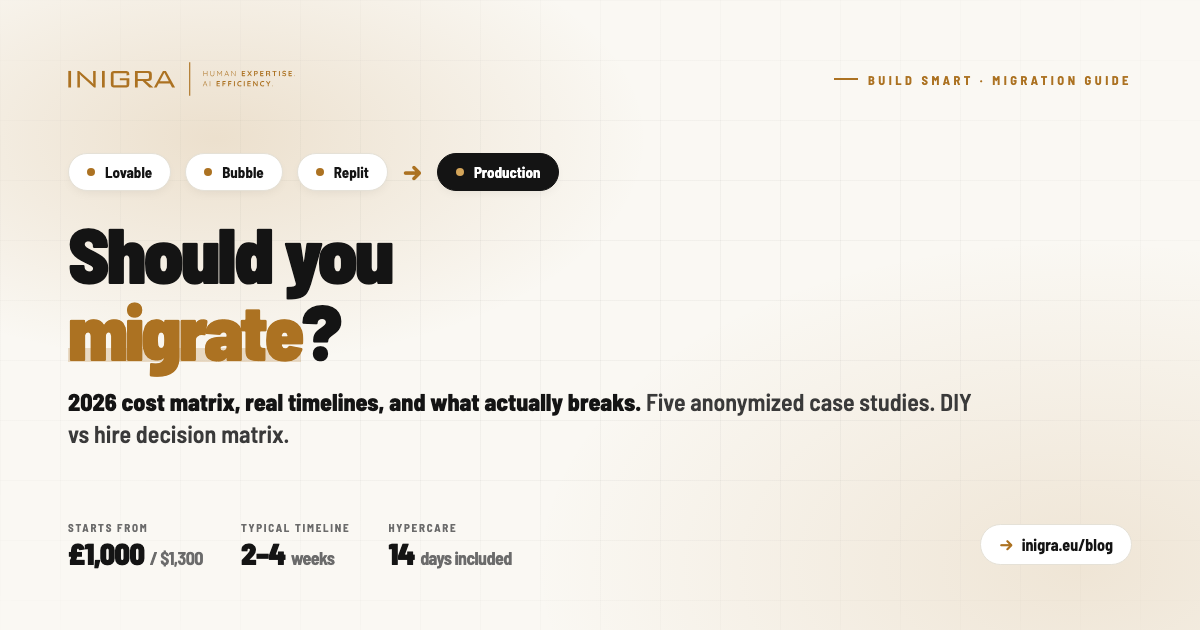
Migrate from Lovable, Bubble, or Replit when monthly platform costs cross ~£150 / $200, you hit a feature ceiling (custom auth, SSO, integrations), or an enterprise customer demands ownership. At Inigra, migrations start from £1,000 / $1,300 / €1,150. A typical SaaS extraction takes 2 to 4 weeks. The five things that break most often: auth, webhooks, deep-link SEO, file uploads, and transactional email. Decision matrix and 5 anonymized case studies below.
The honest answer first: most founders migrate too early or too late
I see both sides every week. A founder migrates at 50 users because they read a thread on X saying Lovable does not scale — and burns six weeks of runway rebuilding something that was working fine. Another founder waits until their Bubble instance is so tangled that the rebuild costs three times what it would have at month six. There is a right window. This post is about how to find it for your own product.
At Inigra we have migrated apps off Lovable, Bubble, Replit, Webflow, and Adalo. Some kept the front-end, some did a full rebuild. Some took ten days, some took eight weeks. Below is the decision framework we walk every founder through before quoting a single hour of work.
5 signals you should migrate now
If at least two of these are true for you today, migration is on the table. If three or more are true, you are almost certainly past the optimal window:
- Vendor cost ceiling. You are paying more than £150 / $200 a month in platform credits (Lovable AI credits, Bubble units, Replit deployments) and your usage will not drop. Migration pays for itself in 12 to 18 months. See The No-Code Credit Trap for the breakdown.
- Feature ceiling. Your roadmap requires something the platform cannot do well: SAML SSO, custom RBAC, multi-tenant data isolation, a binary file processor, a long-running job (more than 30 seconds), a webhook receiver that cannot tolerate 10-second cold starts.
- Enterprise gate. You signed (or are about to sign) a customer who demands SOC 2 evidence, on-prem deployment, custom domain certificates, or audit-grade logging. No-code platforms cannot answer these questions for you.
- IP and exit risk. You are raising a Series A or in due diligence. Investors will ask "where does your code live and can we own it." A platform-locked product reduces your valuation. We unpack this further in From No-Code to Scalable MVP.
- Performance complaints. Users mention "slow" in three or more support messages a week. On Bubble this usually means workflow inefficiency you cannot fully control. On Lovable it often means a chatty client-server pattern the AI generated and never optimized.
If zero of these are true, stay. You are paying £30 a month, your 200 users are happy, and migration is the wrong use of your runway. Come back when one of these flips.
Read our step-by-step technical guide
Hands-on walkthrough: install Git, extract your code, save secrets, move your data, choose a new host, deploy. Written for founders who can copy commands.
Open the migration guideWhat actually breaks during migration (in order of frequency)
Most migration plans underestimate one thing: the cutover is not the hard part. The first 72 hours after cutover are. Here is what we see go wrong, ranked by how often we fix it:
1. Authentication — every user logs out, and they do not all come back
Password hashes are not portable between platforms. Lovable, Bubble, and Replit use their own salt and hash algorithms; you cannot copy the hashes into Supabase Auth or Auth0 directly. The standard fix is to force a "set a new password" flow on first login after cutover. Plan for a 10 to 20 percent re-login drop-off in the first week. Email warm-up before cutover helps cut that in half.
2. Webhooks and integrations — every Zapier, Make, and Stripe URL changes
Every webhook receiver URL changes on cutover day. Stripe, Resend, Twilio, Zapier, Make, Calendly — all of them. The bad version: an engineer changes the URLs at midnight and discovers the next morning that the new Stripe webhook signature secret was never rotated. The good version: dual-write for 48 hours. Keep the old platform receiving webhooks, queue them, and replay against the new backend after cutover. This is the single biggest source of "missed payment" complaints in a migration.
3. Deep links and SEO — Google forgets you in ten days if you skip 301s
If your Bubble app uses /dashboard?u=42 URLs and your Next.js rewrite uses /u/42/dashboard, you need a 301 redirect map. Without it, every external bookmark breaks and Google starts demoting the indexed URLs within two crawl cycles (about ten days). For a SaaS this is usually small. For a content-heavy app it is catastrophic. We had one client lose 40 percent of organic traffic in the first month because they skipped the redirect map.
4. File uploads and storage URLs
Bubble stores files in Bubble-hosted S3 with signed URLs that expire. Lovable uses its own storage. If your database has 12,000 rows referencing https://bubble-storage.io/abc.jpg, every URL needs to be migrated to your new bucket and rewritten in the database. Easy to forget. Painful to fix in production with users actively uploading.
5. Transactional email — your "Welcome" and "Reset password" emails just stop
If you rely on Bubble's or Lovable's built-in mailer, those emails stop the moment you flip DNS. Wire up SendGrid, Resend, or Postmark before cutover. Send yourself a full test journey — signup, reset, invoice — from the new stack 48 hours before.
Real cost matrix: what no-code migration actually costs in 2026
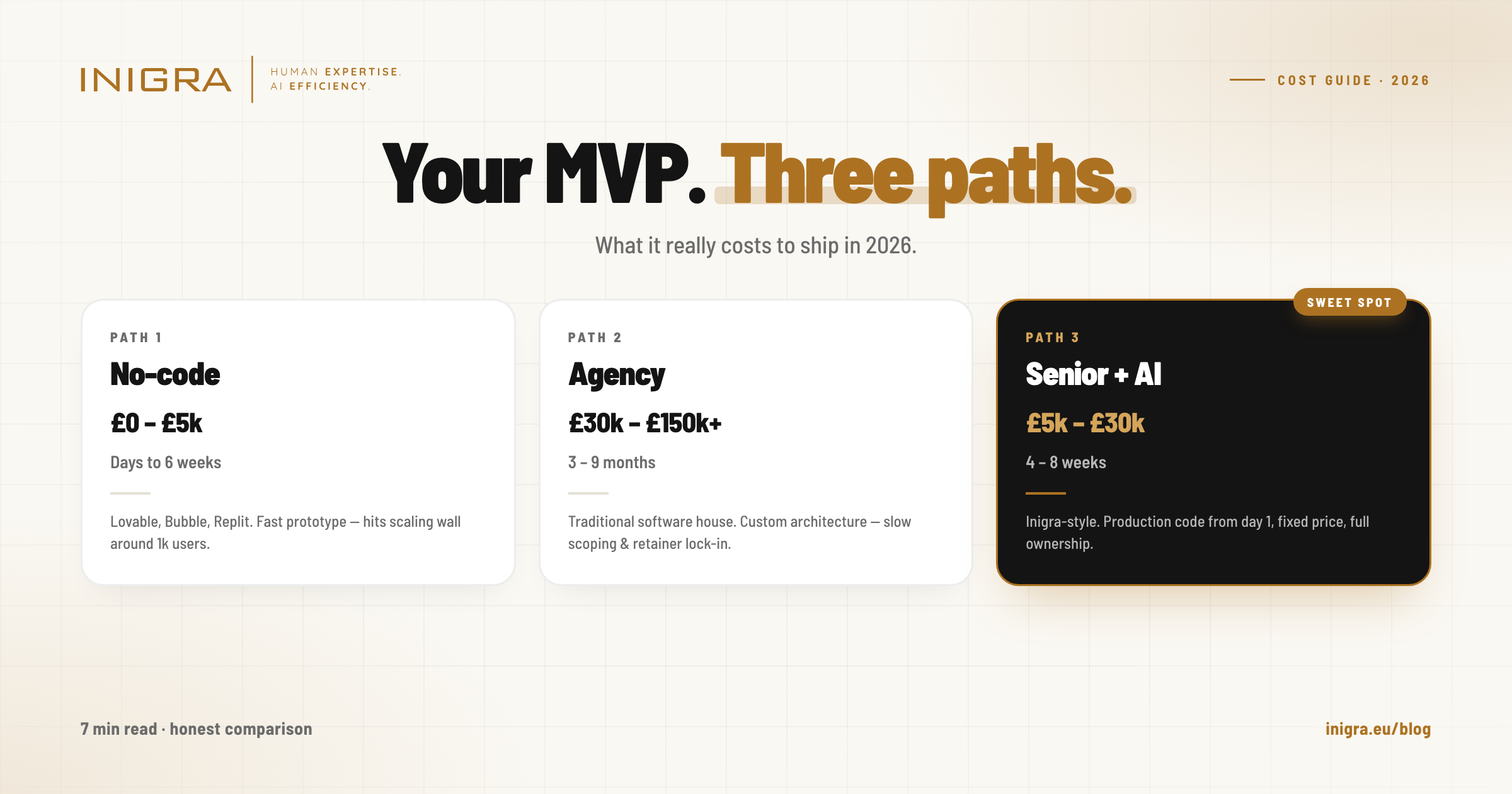
Here is what we quote, by platform and project complexity. All prices are starting points, fixed-quote, senior engineers, with a 14-day support window after cutover. Junior-team agencies will quote less. We are explaining what production-grade engineering with AI assistance costs.
| Source platform | Simple | Standard SaaS | Complex platform |
|---|---|---|---|
| Lovable → React + Node | £1,000 / $1,300 / €1,150 1–2 weeks |
£3,000 – £6,000 2–4 weeks |
£6,000 – £10,000 4–6 weeks |
| Bubble → Next.js + Postgres | £2,000 / $2,600 / €2,300 2 weeks |
£5,000 – £9,000 3–5 weeks |
£9,000 – £15,000+ 6–8 weeks |
| Replit → Vercel / Fly.io | £1,000 / $1,300 / €1,150 1 week |
£2,500 – £5,000 2–3 weeks |
£5,000 – £9,000 3–5 weeks |
| Webflow → Hybrid (keep marketing) | £1,000 / $1,300 / €1,150 1–2 weeks |
£2,500 – £5,000 2–3 weeks |
£5,000 – £8,000 3–5 weeks |
Why Replit is usually cheapest: the code is already standard. We do not have to translate a Bubble workflow into Node — we just have to extract, harden, and host it properly. Replit migrations are the closest thing to a copy-paste.
Why Bubble is usually most expensive: the front-end is not portable. A Bubble app is a configuration that runs inside the Bubble interpreter. You are not extracting a React app, you are rebuilding both layers from a screenshot and a workflow diagram. For founders weighing this from a budget angle, our MVP cost comparison 2026 sets the broader context.
30-min discovery call. No deck, no slides.
Share your Lovable project URL or Bubble app, we tell you what the migration would cost, take, and break. From £1,000 / $1,300 / €1,150.
Book Free Discovery Call5 real migrations (anonymized) — what they cost, what broke, what we learned
Cases below are real Inigra projects. Names, exact metrics and identifying details are changed. Cost figures and timelines are unchanged. Each one starts with what made them decide.
"Our Stripe webhooks were timing out at scale"
Personal budgeting app for crypto-curious users. Built end-to-end in Lovable. Reached 500 paying subscribers at £4.99/mo. Trigger: Lovable's edge functions hit the 10-second cold-start ceiling during subscription renewal weekends, dropping ~3 % of Stripe webhooks. Lost payments = angry users.
We kept Lovable's React frontend (extracted, hardened, deployed to Vercel), rebuilt the backend on Express + Postgres on Fly.io with a proper webhook queue. Cutover on a Tuesday at 4am UK. One user logged a complaint about being signed out.
"Bubble's plugin layer couldn't authenticate against our CDN"
Polish remote-teacher booking platform. 18 months on Bubble, 30,000 students enrolled, 4,000 booked lessons in the database. Trigger: needed Bunny CDN with signed URLs for video lesson playback. Bubble's HTTP plugin could fire the request but could not sign tokens correctly inside the workflow runtime.
Full rebuild — Bubble does not give you a portable frontend. Next.js + Supabase + Bunny CDN. We migrated the database in one batch on a Sunday morning (45-minute downtime, announced 7 days ahead). Re-login forced for all 30,000 users, ~78 % returned within 14 days.
"First enterprise customer demanded SSO. Replit could not."
Sales-call AI summariser built in Replit by a solo technical founder. Working great at 40 self-serve customers. Trigger: signed a 6-figure ARR enterprise deal contingent on SAML SSO and a custom subdomain with the buyer's certificate. Replit's plan at that time did not support custom subdomain certificates.
Easiest of the five. Same Express + React code, lifted onto Vercel + Auth0 with a proper domain setup. We added the SAML integration, audit log, and a basic admin console for the enterprise customer.
"Lovable could not sync inventory at 12 SKUs"
Amsterdam ceramics brand. Founder built a beautiful Lovable storefront experiment. Trigger: inventory sync against their existing fulfilment system was hand-rolled in Lovable and silently drifted; oversold the same vase three times in a week.
Lovable's React frontend ported to Shopify Hydrogen so they got real inventory primitives. Kept the brand-system styling. Migrated the 380 existing customer accounts with re-set-password emails. Total downtime 0.
"Keep the marketing site. Build the booking flow properly."
Private specialist clinic in Poznań. Marketing site on Webflow works perfectly — they did not want to touch it. Trigger: needed a patient booking flow with insurance validation against a Polish national health database. Webflow could not host backend code, and embedding an iframe felt cheap.
Partial migration. Webflow stayed for everything marketing. A Next.js app on a book. subdomain handled the booking flow with Supabase, the insurance integration, and the doctor-side calendar. The two share the same brand kit via shared design tokens.
DIY vs hire — a decision matrix
Founders ask us "should I just do this myself?" The honest answer depends on three things:
| Factor | DIY makes sense if… | Hire makes sense if… |
|---|---|---|
| Your technical level | You can read Git, install Node, debug a webhook | You have to Google "what is npm" |
| Active user count | Under 100 active users, low transactional volume | Paying customers, real revenue, payment flows |
| Time available | You have 60–80 free hours over the next month | You are already at capacity selling and supporting |
| Risk tolerance | Downtime is annoying, not catastrophic | An hour of downtime = a churned customer |
| Compliance gates | None — internal tool, B2C consumer app | GDPR DPO, HIPAA, SOC 2 evidence required |
If you land mostly in the left column, our step-by-step migration guide will get you there. It is written for a founder who can copy commands. If you land mostly in the right column, the migration is not the place to learn. Book a discovery call and let us scope it.
What the next 30 days look like with us
For founders who decide to hire it out, this is the rhythm we run:
- Day 0–1. 30-minute discovery call. You share the Lovable project URL or invite us to the Bubble editor. We come back within 48 hours with a fixed quote and a migration plan.
- Day 2–4. Audit phase. We map every workflow, every integration, every database table. Sign-off on scope.
- Day 5–18. Build phase. Daily Loom updates, weekly demo. You can pause us at any milestone — we work in two-week sprints.
- Day 19–21. Dry run. Full migration into a staging environment. Real data, real integrations, no users.
- Day 22. Cutover. 4am UK Tuesday or Sunday morning. We watch logs for 6 hours.
- Day 23–37. Hypercare. 14 days of bug-fix and on-call coverage from the same engineer who built it. Included in the fixed price.
FAQ
How much does it cost to migrate a Lovable, Bubble, or Replit app to production code in 2026?
At Inigra, no-code migrations start from £1,000 / $1,300 / €1,150 for a simple read-only app extraction. A typical SaaS migration with authentication, database, and a payment provider lands between £3,000 and £8,000. Complex multi-workflow platforms (Bubble apps with 30+ workflows, custom plugins, complex permissions) can run £8,000 to £15,000+. Cost is driven by workflow count, integration complexity, data volume, and whether you keep the front-end or rebuild it.
How long does it take?
Simple single-flow apps: 1 to 2 weeks. Standard SaaS with auth, database, and payments: 2 to 4 weeks. Complex multi-feature platforms with custom workflows and integrations: 4 to 8 weeks. Timeline depends primarily on data complexity (how many tables, how clean the no-code schema is) and the number of third-party integrations to re-wire.
What usually breaks when you migrate away from a no-code platform?
Five things break most often: (1) Authentication — user sessions reset because password hashes are not portable between platforms. You need a forgot-password flow on day one. (2) Webhooks and integrations — every Zapier, Make, or Stripe webhook URL changes. (3) Deep links and SEO — old Bubble or Lovable URLs need 301 redirects, otherwise rankings drop. (4) File uploads — Bubble S3 buckets, Lovable storage URLs need migration. (5) Email — transactional emails sent via the no-code platform stop unless you wire up SendGrid or Resend before cutover.
Can I keep my Lovable or Bubble frontend and only migrate the backend?
With Lovable, often yes — Lovable generates React code that can be extracted and self-hosted on Vercel or Netlify while you replace the backend with Node, Postgres, and Stripe. With Bubble, it is much harder because the front-end is a Bubble interpreter, not portable code. A Bubble migration is usually a full rebuild of both layers. Replit projects are typically the easiest to migrate because the code is already standard Node, Python, or React — you mostly need to extract it, fix the secrets, and pick a new host.
Should I migrate from Lovable or stay on the platform?
Migrate when at least one of these is true: (1) You are paying more than £150 / $200 a month in Lovable credits and your usage will not drop. (2) You hit a feature ceiling (custom auth, advanced integrations, complex data permissions). (3) You signed an enterprise customer who demands SSO, SOC 2, or on-prem deployment. (4) You need IP ownership for a fundraise or acquisition. (5) Performance is degrading and users are noticing. If none of these apply, stay on the platform — premature migration burns budget you do not need to spend yet.
What is the difference between this article and the Inigra migration guide?
This article is a decision and cost guide — when to migrate, what it costs, what breaks, and how to choose between DIY and hiring help. The Inigra Moving Your Project guide at /nocodemigration/ is a hands-on technical walkthrough: how to install Git, extract your code, save your secrets, move your data, and deploy to a new host. Use this article to decide; use the guide to execute.
Do you guarantee zero downtime?
For most SaaS migrations, yes. The cutover happens via DNS swap with both environments running in parallel for 6 to 24 hours. Bubble migrations require a 30–60 minute maintenance window because the database export-import is sequential. We announce it 7 days ahead.
Thinking about migrating? Send me the Lovable URL.
Paweł Reszka, Founder & CTO at Inigra
pawel.reszka@inigra.eu · LinkedIn