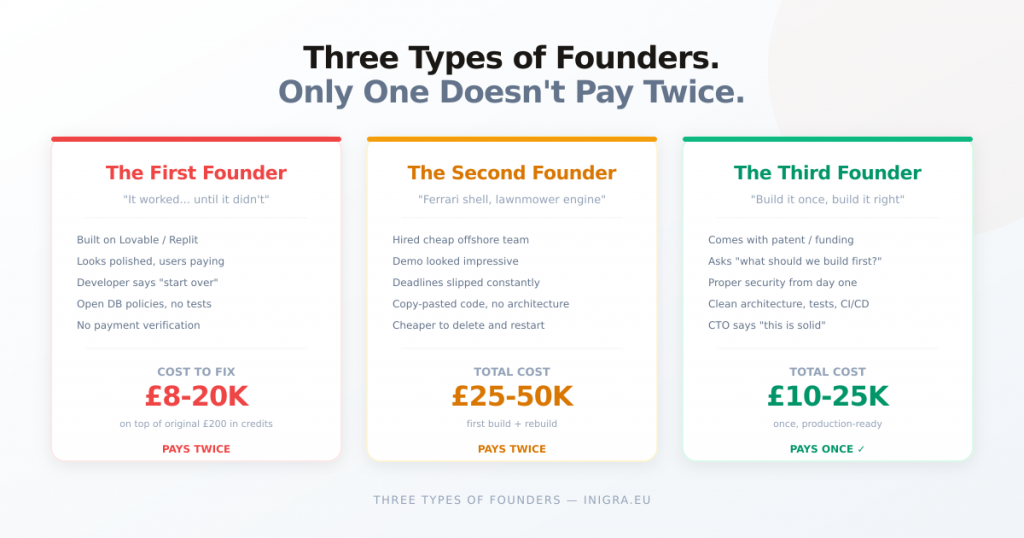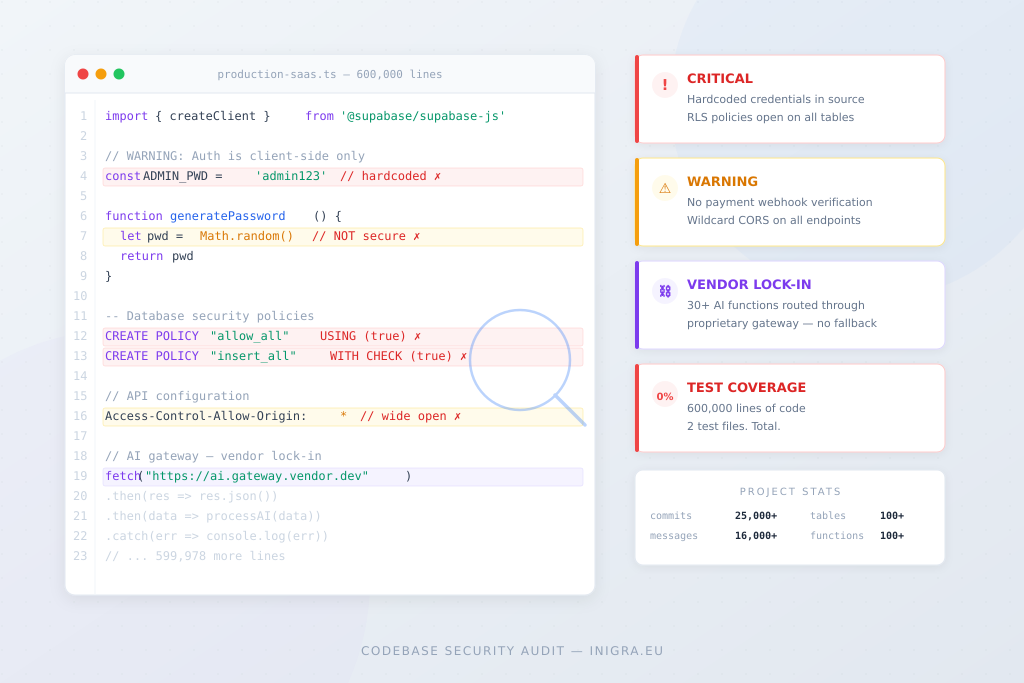

AI tools like Lovable allow founders to build MVPs faster than ever.
In days — not weeks — you can validate an idea, test user flows, and show something real to users or investors.
But once the product starts working, a key question appears:
How do we turn this into a real, scalable product?
Here’s how that transition looks in practice.
Why Lovable Is a Great Start (But Not the Finish Line)
Lovable is excellent for:
-
rapid prototyping,
-
early UX validation,
-
demos and proof of concept,
-
testing assumptions with real users.
Where founders usually hit a wall is when they need:
-
more complex logic,
-
stable backend control,
-
integrations,
-
performance and security,
-
scalability.
At that point, the MVP is validated — but the technology isn’t ready to scale.
Step 1: Treat Lovable as a Product Blueprint
The first rule:
Lovable is not production code.
What we reuse:
-
user flows,
-
screens and UX decisions,
-
validated product logic.
What we don’t reuse:
-
generated backend logic,
-
database structure,
-
authentication and scaling setup.
Think of Lovable as a living product specification, not something to extend forever.
Step 2: Re-Scope the Real MVP Core
Lovable MVPs often include features that were easy to add but hard to maintain.
Before rebuilding, we ask:
-
What is the ONE core user journey?
-
What features were added just for the demo?
-
What can be safely removed from version one?
This step is crucial — it keeps the rebuild lean and prevents budget creep.
Step 3: Design a Scalable Architecture (Before Coding)
This is where no-code projects usually struggle later.
For a real MVP, we define:
-
backend structure (API-first),
-
database model,
-
authentication & permissions,
-
environments (dev / staging / prod),
-
deployment setup.
The goal is not overengineering — it’s building something stable enough to grow.
Step 4: Rebuild the Core — Fast
Founders often expect rebuilding to take months.
In reality, it’s much faster because:
-
UX decisions are done,
-
flows are validated,
-
product direction is clear.
We focus on:
-
rebuilding the core workflow,
-
keeping the UI clean and simple,
-
prioritizing correctness over polish.
This is where real code MVPs move surprisingly fast.
Step 5: Add Only Necessary Integrations
Early MVPs often avoid real integrations or simulate them.
When scaling, we add only what supports real usage:
-
payments,
-
email,
-
analytics,
-
selected third-party tools.
Everything else stays out until it’s actually needed.
What Founders Gain by Moving to Real Code
The transition from Lovable to full-stack development gives you:
-
full control over logic and data,
-
freedom to scale users and features,
-
easier integrations,
-
better investor confidence,
-
lower long-term costs.
Most importantly, your MVP stops being a prototype — and becomes a real product. Read more
Final Thought: AI to Start, Engineering to Scale
AI and no-code tools are perfect for getting started.
But scalable products still require real engineering.
The smartest approach isn’t AI vs code — it’s:
AI to validate. Code to scale.
Thinking About Scaling Your Lovable MVP?
At Inigra, we help founders:
-
validate ideas with AI and no-code,
-
transition to real, scalable code,
-
build market-ready MVPs without overengineering. Read more
If you want to understand how your Lovable MVP could be rebuilt into a real product,
book a free 30-minute Discovery Call — we’ll walk you through the process and costs.