
What it really costs to build a minimum viable product, based on 30+ projects we’ve shipped. No vague ranges. No “it depends” cop-outs. Actual numbers.
Most articles about MVP costs give you useless ranges like “anywhere from $5,000 to $500,000.” That’s not helpful. That’s a cop-out.
I run a software house in Poland. We specialize in MVPs for funded startups. Over the past few years, we’ve shipped 30+ MVPs across fintech, healthtech, SaaS, marketplaces, and internal tools.
Here’s what things actually cost — and why.
The three tiers of MVP development
After dozens of projects, I’ve found that MVPs cluster into three categories. Not because we designed it that way, but because founder needs naturally fall into these buckets.
Tier 1: Validation MVP — £5,000 to £10,000
What you get: One core flow, functional but minimal. Enough to put in front of users and learn if your idea has legs.
Timeline: 2-4 weeks
Typical scope:
- Single user type (no admin panel)
- One core workflow (e.g., “user signs up, submits request, gets result”)
- Basic authentication
- Simple, clean UI (not custom design)
- Deployed and working
Real example: A founder came to us with an idea for a compliance checking tool. We built a single flow: user uploads document → AI extracts data → user reviews results. No dashboard, no team features, no billing. Total: £7,500, delivered in 3 weeks. She used it to validate demand before investing more.
Who this is for: You have an idea but aren’t sure it’ll work. You want to test before committing £20K+.
Tier 2: Standard MVP — £10,000 to £20,000
What you get: A real product with the core features needed to acquire and retain early users. This is what most people mean when they say “MVP.”
Timeline: 4-8 weeks
Typical scope:
- User authentication (email, Google, maybe magic links)
- 3-5 core features that deliver the main value proposition
- Basic admin panel or dashboard
- Payment integration (Stripe, usually)
- Responsive design (mobile-friendly)
- Analytics setup
- CI/CD pipeline (we can ship updates fast post-launch)
Real example: A B2B SaaS for recruitment. Users could sign up, connect their CRM, see a dashboard with insights, and upgrade to paid. Admin panel let the founder see metrics and manage users. Total: £14,000, delivered in 6 weeks. They raised a seed round 4 months later.
Who this is for: You’ve validated the idea (through research, a waitlist, or a Tier 1 MVP). Now you need a product good enough to charge money for.
Tier 3: Advanced MVP — £20,000 to £35,000+
What you get: Complex business logic, multiple user types, integrations, or anything that requires more architectural thinking upfront.
Timeline: 8-12 weeks
Typical scope:
- Multiple user roles (e.g., customers, vendors, admins)
- Complex workflows or multi-step processes
- Third-party integrations (APIs, payment providers, data sources)
- Real-time features (chat, notifications, live updates)
- Multi-tenant architecture (for SaaS with workspaces/teams)
- More sophisticated UI/UX
Real example: A marketplace connecting freelancers with clients. Both sides had onboarding flows, profiles, search/matching, messaging, booking, payments with escrow, reviews, and an admin panel. Total: £28,000, delivered in 10 weeks.
Who this is for: Your product is inherently complex. Two-sided marketplaces, fintech with compliance requirements, healthcare with data sensitivity.
BOOK FREE DISCOVERY CALL WITH OUR CEO PAWEŁ RESZKA
What drives cost up (and down)
After 30+ projects, these are the factors that actually move the needle:
Things that increase cost
| Factor | Impact | Why |
|---|---|---|
| Multiple user types | +30-50% | Each role needs its own flows, permissions, UI |
| Real-time features | +20-40% | WebSockets, state sync, edge cases |
| Third-party integrations | +10-30% each | APIs are never as clean as documented |
| Custom design | +15-25% | Off-the-shelf UI is fast; bespoke design isn’t |
| Regulatory compliance | +20-40% | HIPAA, GDPR, PCI-DSS add process overhead |
| Native mobile apps | +50-100% | Two platforms, app store review, device testing |
Things that keep cost down
| Factor | Impact | Why |
|---|---|---|
| Clear scope upfront | -10-20% | Less back-and-forth, fewer surprises |
| Existing design/wireframes | -10-15% | We’re not starting from scratch |
| Flexible on tech stack | -5-10% | We use what’s fastest for the job |
| Prioritized feature list | -15-25% | We build what matters, cut what doesn’t |
| Trust the process | -10-15% | Fewer revision cycles, faster decisions |
The hidden costs nobody tells you about
The development cost is not the total cost. Budget for these:
1. Infrastructure — £50-500/month
Hosting, database, CDN, email service, monitoring. For an MVP, usually £50-150/month. Scales with usage.
2. Third-party services — £0-500/month
Stripe fees (2.9% + 30p per transaction), analytics tools, error tracking, email marketing, etc.
3. Post-launch iteration — £2,000-5,000
Your first version will need changes after real users touch it. Budget for 2-4 weeks of iteration work.
4. Your time
Even with a dev team, you’ll spend 5-10 hours/week on feedback, decisions, and testing. More if you’re technical.
Poland vs. UK/US: The cost difference
I run a Polish software house, so let me be transparent about the math:
| Location | Typical MVP cost (Standard tier) | Why |
|---|---|---|
| US (Bay Area) | $80,000-150,000 | High salaries, expensive everything |
| UK (London) | £40,000-80,000 | Still expensive, but less than SF |
| Western Europe | €35,000-70,000 | Germany, Netherlands, France |
| Poland | £10,000-20,000 | Strong talent, lower cost of living |
| Ukraine/Baltics | £8,000-18,000 | Similar to Poland |
| India/Pakistan | £5,000-12,000 | Lower cost, but often quality/communication tradeoffs |
We’re not the cheapest. We’re the best value for founders who want quality output, direct communication with senior developers, and EU timezone overlap.
BOOK FREE DISCOVERY CALL WITH OUR CEO PAWEŁ RESZKA
What you should actually budget
Here’s my honest advice depending on your situation:
Pre-seed / Bootstrapped
Budget: £5,000-10,000
Strategy: Build a Validation MVP. Test the core assumption. Don’t over-build.
Seed-funded / Strong savings
Budget: £15,000-25,000
Strategy: Build a Standard MVP that can acquire paying customers. Include analytics so you can prove traction.
Series A / Well-funded
Budget: £25,000-50,000+
Strategy: Build for scale from day one. Invest in architecture, testing, and infrastructure.
Red flags when comparing quotes
If someone quotes you significantly below these ranges, ask:
- Who’s actually doing the work? (Junior devs? Outsourced to another country?)
- What’s included? (Design? Testing? Deployment? Post-launch support?)
- What’s the revision policy? (Two rounds? Unlimited? None?)
- Who owns the code? (You should. Always.)
- What happens after launch? (Can they continue? At what rate?)
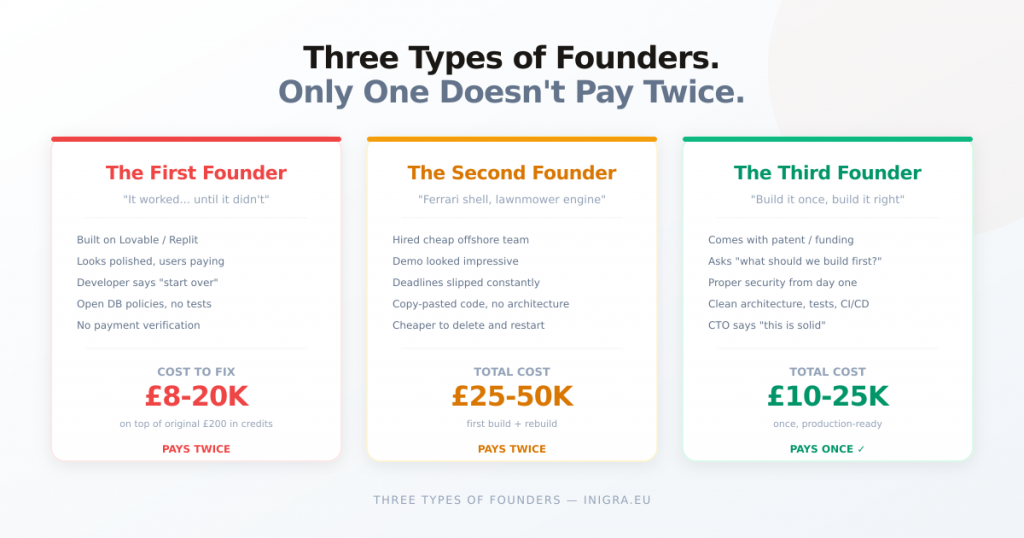
Cheap quotes often become expensive projects when you’re rebuilding 6 months later.
How to get an accurate quote
When you reach out to a dev shop (including us), come prepared with:
- One paragraph describing the product — What does it do? Who is it for?
- The core user flow — What’s the main thing a user does?
- A rough feature list — Even bullet points help
- Your timeline — When do you need it?
- Your budget range — We’ll tell you what’s realistic within it
The more clarity you provide, the more accurate the estimate.
The bottom line
Building an MVP in 2026:
- Validation MVP: £5,000-10,000 (2-4 weeks)
- Standard MVP: £10,000-20,000 (4-8 weeks)
- Advanced MVP: £20,000-35,000+ (8-12 weeks)
Add 20-30% buffer for post-launch iteration and hidden costs.
Don’t pay Bay Area prices for work that can be done at equal quality in Europe. Don’t pay bottom-dollar rates and get code you’ll have to throw away.
Find the middle ground: experienced team, clear communication, fair price, and a codebase you can actually build on.
Want a quote for your MVP? Book a free discovery call — I’ll give you an honest estimate within 48 hours. If we’re not the right fit, I’ll tell you that too.