No-code tools like Bubble, Lovable, Replit, and AI-generated builders are an incredible shortcut for launching early prototypes. They allow founders to validate ideas quickly without hiring developers.
But once the product attracts real users — performance drops, features break, and growth becomes impossible.
At Inigra Software House, most of the founders who contact us come with the same problem:
“Our no-code MVP worked for testing, but now users complain, and we can’t add new features.”
Here’s why it happens — and what to do next.
No-code apps rely on heavy visual builders and auto-generated workflows.
When 10 people use the app — everything looks fine.
When 100+ people join — issues appear immediately:
-
slow page loads
-
automation delays
-
broken workflows
-
database timeouts
No-code platforms don’t optimize queries or infrastructure.
You can’t upgrade the backend — you can only upgrade your subscription.
As soon as your idea requires more than simple CRUD operations, no-code tools begin to struggle.
Examples we see often:
-
multi-step automations fail
-
API integrations stop working
-
permissions become messy
-
database relationships get chaotic
-
performance drops with every new feature
The more complex your product becomes, the more fragile the no-code logic becomes.
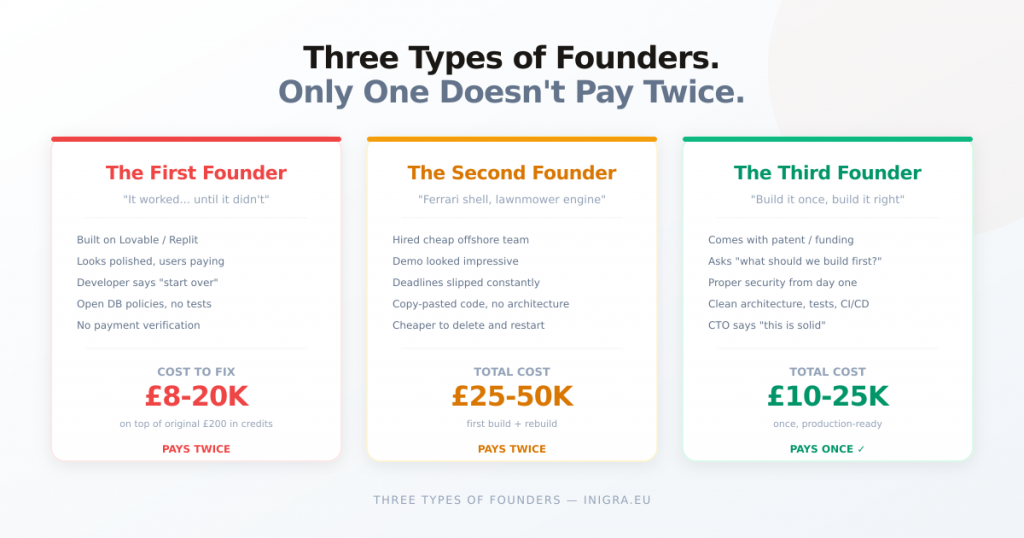
Founders often believe no-code is always cheaper.
This is true only at the beginning.
But later:
-
plugins cost money
-
complex workflows are slow and difficult
-
reworking broken features takes more time
-
you need specialists who charge more for no-code fixes
-
hosting costs increase rapidly
At a certain point, rebuilding the app in custom code is cheaper than keeping it alive in Bubble or Lovable.
With no-code you cannot:
-
optimise backend queries
-
add caching
-
control server resources
-
adjust database indexing
-
improve API speed
-
implement efficient architecture
You are locked inside the platform.
If it’s slow — there is nothing you can do.
Most founders outgrow no-code when they want:
-
real-time features
-
scalable SaaS architecture
-
advanced payments
-
messaging
-
custom dashboards
-
AI features
-
mobile apps
-
multi-tenant systems
These require a real backend, real structure and real engineering.
You should transition from no-code to custom code when:
1) Users start complaining about speed or bugs
That’s the #1 sign.
2) Each new feature takes longer than expected
Your MVP is hitting limitations.
3) You plan to raise investment
Investors expect scalability.
4) You have more than 50–100 active users
Most no-code apps break at this level.
This is where a software house like Inigra comes in.
We rebuild no-code prototypes using a scalable tech stack such as:
-
Next.js
-
React
-
Node.js
-
NestJS
-
Flutter
-
PostgreSQL
-
Google Cloud Platform
You get:
✔ fast performance
✔ clean code
✔ scalable backend
✔ easy integration with any API or AI model
✔ mobile + web support
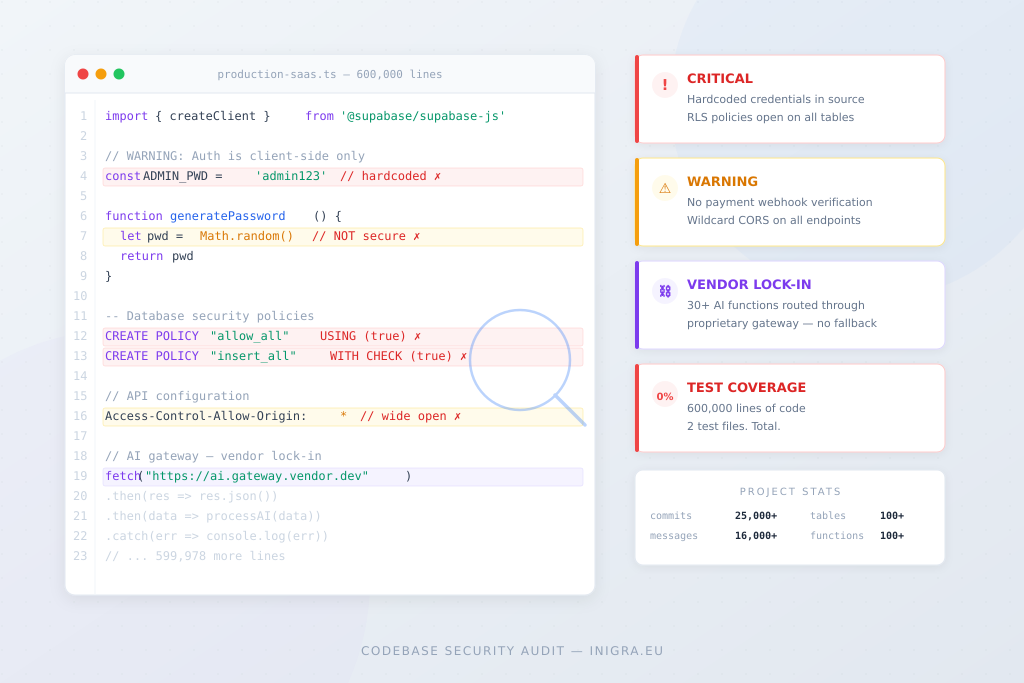
✔ no vendor lock-in
And the rebuild usually takes 6–10 weeks.
Conclusion
No-code is perfect for validating ideas — but not for long-term scaling.
If your app is getting slower, harder to maintain, or painful to extend, rebuilding into custom code is not just a technical decision — it’s a business advantage.
Your product can only grow on a foundation designed to grow.
Ready to scale beyond no-code?
Book a free 30-minute Discovery Call with our CTO, Paweł Reszka, and we’ll analyse your no-code prototype together.