
Inigra Sp. z o.o.
Office: Piekary 7, Poznań, Poland
VAT-ID: 6492316515
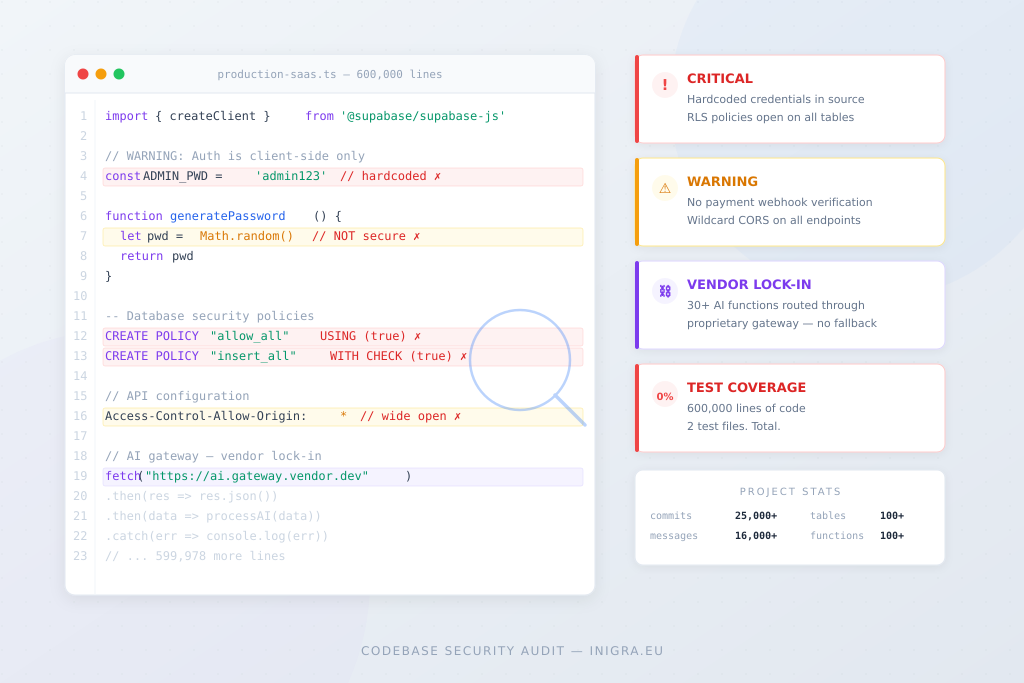
We recently reviewed a codebase that was built almost entirely by AI. Not a prototype. Not a side project. A live, paying SaaS platform with real users, Stripe billing, and an enterprise feature set.
The numbers are staggering:
By any measure, this is an impressive achievement. A single person with no coding background built a production SaaS platform that would have taken a traditional development team 12-18 months and six figures in budget. The UI is polished. The feature set is comprehensive. Users are signing up and paying.
But then we looked under the hood.
The biggest issue wasn’t a bug. It wasn’t a missing feature. It was architecture.
The platform relies heavily on AI-powered features – they’re the core product, not a nice-to-have. Content generation, analysis, translation, recommendations – all powered by AI. In total, over 30 serverless functions handle AI operations.
Every single one of them routes through the no-code platform’s proprietary AI gateway.
Not OpenAI directly. Not Anthropic. Not any API the founder controls. A gateway URL owned and operated by the platform the app was built on.
This means:
The founder built an entire business on top of infrastructure they don’t control and can’t replicate. The AI features ARE the product – without them, the platform is an empty shell. That’s not a technical limitation. That’s a business risk most founders don’t know they’re carrying.
We’ve now reviewed dozens of AI-generated codebases. The same patterns show up every single time. This project was no different.
Passwords generated with Math.random()
Two separate functions generate temporary passwords for new users using JavaScript’s Math.random(). This is not cryptographically secure – the output is predictable and can be reproduced. The fix is one line (crypto.getRandomValues()), but the AI chose the simpler option every time.
Row-level security that started wide open
The database had RLS enabled across the board with nearly 500 security policies – impressive numbers. But for the first two months of the project, critical tables had policies set to USING (true), meaning any authenticated user could read, modify, or delete any row in those tables. The AI eventually generated a security fix migration, but the platform was live with open policies for weeks before that happened.
Wildcard CORS on every endpoint
Every single serverless function uses Access-Control-Allow-Origin: *. This means any website on the internet can make requests to the platform’s API endpoints. For a SaaS handling user data and processing payments, this should be locked down to the platform’s own domain.
No payment webhook verification
The platform charges users via Stripe. It has a checkout flow and a customer portal. But there is no Stripe webhook handler to verify that payments actually completed. The credit system resets monthly on a scheduled cron job based on a date stored in the database – regardless of whether Stripe successfully collected the payment. If a card declines, the user could still receive their monthly credits.
The project has over 600,000 lines of code and 2 test files.
Two.
One tests accessibility. One tests a styling utility function. There are zero tests for:
This isn’t unusual for AI-generated code. The AI builds features when you ask for features. It doesn’t write tests unless you specifically ask for tests. And most non-technical founders don’t know to ask.
The app loads 11 Google Font families on every single page. That’s roughly 500KB of font files before any content renders. Most pages use one or two of these fonts. The rest are loaded and never used.
This is a classic AI pattern – the founder asked for a font change at some point, the AI added it, and the previous font imports were never removed. Multiply this by hundreds of iterations and you get a bloated page load.
One serverless function is over 3,000 lines long. Another exceeds 1,500 lines. A well-structured function is typically 50-200 lines. These are unmaintainable by any developer – human or AI.
The AI doesn’t refactor. It adds. When a function needs new capability, the AI appends code rather than restructuring. Over thousands of iterations, functions grow into monoliths that no one can safely modify without breaking something else.
It would be dishonest to only talk about what went wrong. The AI built genuinely impressive things:
The founder built a platform that competes with established products that took years and millions to develop. That’s real. The AI made it possible.
The problem isn’t that AI-generated code is bad. Much of it is good. The problem is that AI-generated code is consistently good at the things that are visible (UI, features, user flows) and consistently weak at the things that are invisible (security, performance, testing, architecture decisions, vendor dependencies).
A founder looking at their working app sees a product ready to scale. A developer looking at the same codebase sees a list of things that will break under pressure.
The 600,000 lines work today. The question is whether they’ll work when:
None of these are hypothetical. We’ve seen every one of them happen in production.
If you’ve built your product on a no-code platform with AI, here’s what we’d recommend:
Right now (free, takes an hour):
Math.random in any security context – replace with crypto.getRandomValues()USING (true) and understand which tables are wide openBefore you scale:
Before you raise funding or sell:
The AI got you to market. That’s the hard part. Now it’s time to make sure what you built can survive contact with the real world.
We audit AI-generated codebases every week. If you want to know what’s in yours before your users find out, we offer free security reviews for projects built on Lovable, Replit, Base44, and Bolt. Details at inigra.eu/nocodemigration


We’ll review your idea, discuss the next steps, and suggest the best way to bring your product to life.


