Short answer: vibe coding means building software by describing what you want to an AI in plain language and running what it produces - steering by results and "vibe" rather than reading every line of code. It is brilliant for getting an idea to a working demo in hours. It becomes a problem the moment real users, real data and real money arrive, because "it runs" and "it is safe, stable and scalable" are two very different things. Here is what vibe coding actually is, why vibe-coded apps break at scale, and how to take one to production without starting over.
What is vibe coding?
Vibe coding is a way of building software where you describe the outcome you want to an AI, run what it generates, and keep prompting until it works - accepting most of the code without reviewing it line by line. Instead of thinking in functions and data structures, you think in intentions: "add a login," "make the dashboard show this," "fix that bug."
The term was coined by Andrej Karpathy - a co-founder of OpenAI and the former director of AI at Tesla - in early 2025, describing a style where you "fully give in to the vibes" and almost forget the code exists. What began as a fun, fast way to prototype quickly became how thousands of founders build their first real product.
Which tools are used for vibe coding?
Vibe coding is not one tool - it is an approach that runs across a whole category of AI builders and assistants:
- AI app builders: Lovable, Bolt, Replit Agent and v0 by Vercel - describe an app, get a working full-stack project.
- No-code and low-code with AI: Bubble and Webflow AI - visual builders with AI generation layered on top.
- AI coding assistants: Cursor, GitHub Copilot, Claude Code and ChatGPT - for people who do open the code, but let the AI write most of it.
They all share the same promise: get from idea to a running product faster than ever before. And they genuinely deliver on it.
Is vibe coding good or bad?
Neither - it is a tool, and an excellent one for the right job. Vibe coding is fantastic for validating an idea, building a prototype to show investors or early users, spinning up internal tools, and getting a founder unstuck without hiring a developer on day one. If the goal is "prove the concept fast," it is one of the best things to happen to product building.
The trouble is not the tool - it is treating a prototype as if it were a production system. AI optimises for "it works right now," not for "it is secure, it scales, and someone actually understands it." That gap is invisible in a demo and very expensive once real users show up.
We review, harden and rebuild AI-built apps for production - keeping what already works.
Why do vibe-coded apps break at scale?
An app can look finished and still be missing the parts that only matter under real load. These are the issues we see again and again when founders bring us a vibe-coded app to review:
- Security gaps. API keys exposed in the frontend, missing access controls so one user can read another user's data, and inputs that are never validated. The demo works; the data is not safe. (We wrote up the most common ones in the 9 security holes we keep finding in AI-built apps.)
- No real authentication or authorization. "Logged in" is not the same as "only allowed to see their own records."
- Race conditions and fragile state. Fine with one person clicking slowly; broken with hundreds acting at once.
- No tests and no error handling. Failures happen silently, so you hear about them from customers instead of your logs.
- Architecture that does not scale. Queries and data structures that are fine for 10 rows fall over at 10,000.
- Nobody understands the code. Because it was generated rather than designed, there is no mental model of how it fits together - so when it breaks, the AI often cannot fix what it never really understood, and neither can you.
None of this means you did anything wrong. It is simply the difference between "it works in the demo" and "it holds up for real users."
Signs your vibe-coded app has outgrown the tool
- Real users are signing up - and some are paying.
- You are storing personal data, payments, or anything you would hate to leak.
- Every new feature seems to break two old ones.
- The AI keeps "fixing" bugs by quietly introducing new ones.
- You cannot confidently answer three questions: is it secure, will it scale, and do I actually own the code?
If two or more of those are true, the app has done its job as a prototype - and it is ready for real engineering.
How do you take a vibe-coded app to production?
You almost never need to throw it away and start over. The usual path is to keep what works and rebuild the parts that matter:
- Review what is there. An honest look at the code, the data model and the security holes, so you know exactly where you stand.
- Lock down security first. Move secrets out of the frontend, add real authentication and authorization, validate inputs and close data-access gaps.
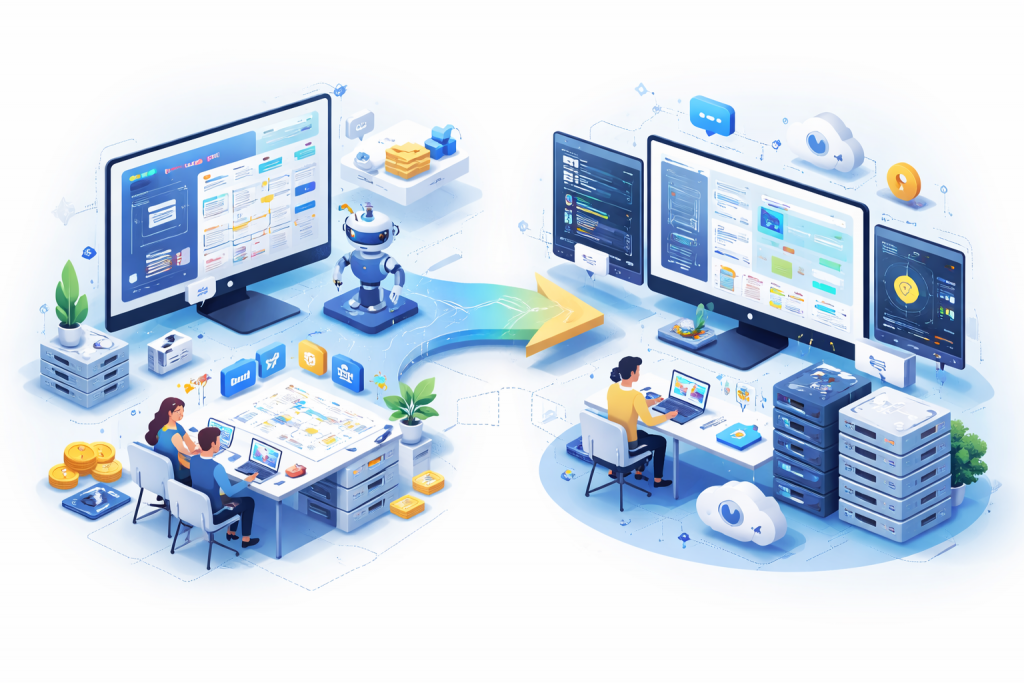
- Put in real architecture. A database and structure that scale, proper error handling, and a deployment you can trust. (This is the heart of any migration from a no-code prototype to a scalable MVP.)
- Add tests and monitoring. So failures surface in your dashboards, not in angry emails.
- Make sure you own it. Full code ownership, no lock-in, ready to hand off - it is your asset, not the platform's.
Done right, your users never notice a thing - except that the app stops breaking. If you are weighing this up, we broke down the real costs and timelines of migrating to production separately.
Vibe coding vs. production engineering: when to use each
| Vibe coding is great for | You need production engineering when |
|---|---|
| Prototypes and MVPs | Real users depend on the app |
| Validating an idea fast | You store personal data or take payments |
| Internal tools and demos | It has to scale beyond a handful of users |
| Getting unstuck without a dev team | Security, uptime and maintainability matter |
The bottom line
Vibe coding is a genuine breakthrough for getting ideas built fast, and if you have shipped something real with it, that is a real head start. The one thing the apps that reach real users all get right is not the feature list - it is having a real engineer who actually understands what is under the hood, so the product is secure, scalable and truly yours.
Frequently asked questions
What is vibe coding, in one sentence?
Building software by describing what you want to an AI in plain language and running what it generates, largely without reviewing the code yourself - great for fast prototypes and MVPs.
Who coined the term "vibe coding"?
Andrej Karpathy, a co-founder of OpenAI and former director of AI at Tesla, coined it in early 2025 to describe letting an AI write the code while you steer by results.
Is vibe coding good or bad?
It is excellent for prototypes, MVPs and internal tools. It becomes a problem only when a prototype is treated as a production system, because AI optimises for "it works," not for security, scale or maintainability.
Why do vibe-coded apps break at scale?
Exposed API keys, missing access controls, no real authentication, race conditions, no tests or error handling, and architecture that cannot handle load. It runs in a demo but is not safe or stable for real users.
Can you take a vibe-coded app to production?
Yes - usually without starting over. Review the app, fix security first, add real architecture, tests and monitoring, and make sure you fully own the code. Keep what works, rebuild what matters.