Category: Blog – Inigra Software House

  • Why No-Code MVPs Fail to Scale: The Technical Breakdown Every Founder Should Know

    Why No-Code MVPs Fail to Scale: The Technical Breakdown Every Founder Should Know

    No-code tools like Bubble, Lovable, Replit, and AI-generated builders are an incredible shortcut for launching early prototypes. They allow founders to validate ideas quickly without hiring developers.

    But once the product attracts real users — performance drops, features break, and growth becomes impossible.

    At Inigra Software House, most of the founders who contact us come with the same problem:

    “Our no-code MVP worked for testing, but now users complain, and we can’t add new features.”

    Here’s why it happens — and what to do next.

    1. No-Code MVPs Aren’t Built for Real Traffic

    No-code apps rely on heavy visual builders and auto-generated workflows.
    When 10 people use the app — everything looks fine.
    When 100+ people join — issues appear immediately:

    • slow page loads

    • automation delays

    • broken workflows

    • database timeouts

    No-code platforms don’t optimize queries or infrastructure.
    You can’t upgrade the backend — you can only upgrade your subscription.

    2. Complex Logic Breaks Fast

    As soon as your idea requires more than simple CRUD operations, no-code tools begin to struggle.

    Examples we see often:

    • multi-step automations fail

    • API integrations stop working

    • permissions become messy

    • database relationships get chaotic

    • performance drops with every new feature

    The more complex your product becomes, the more fragile the no-code logic becomes.

    3. Scaling Costs More Than Rebuilding

    Founders often believe no-code is always cheaper.
    This is true only at the beginning.

    But later:

    • plugins cost money

    • complex workflows are slow and difficult

    • reworking broken features takes more time

    • you need specialists who charge more for no-code fixes

    • hosting costs increase rapidly

    At a certain point, rebuilding the app in custom code is cheaper than keeping it alive in Bubble or Lovable.

    4. You Can’t Control Performance or Optimisation

    With no-code you cannot:

    • optimise backend queries

    • add caching

    • control server resources

    • adjust database indexing

    • improve API speed

    • implement efficient architecture

    You are locked inside the platform.
    If it’s slow — there is nothing you can do.

    5. Advanced Features Are Hard or Impossible

    Most founders outgrow no-code when they want:

    • real-time features

    • scalable SaaS architecture

    • advanced payments

    • messaging

    • custom dashboards

    • AI features

    • mobile apps

    • multi-tenant systems

    These require a real backend, real structure and real engineering.

    When Should You Rebuild? (The 4 Clear Signs)

    You should transition from no-code to custom code when:

    1) Users start complaining about speed or bugs

    That’s the #1 sign.

    2) Each new feature takes longer than expected

    Your MVP is hitting limitations.

    3) You plan to raise investment

    Investors expect scalability.

    4) You have more than 50–100 active users

    Most no-code apps break at this level.

    What’s the Solution? Rebuilding With a Real Architecture

    This is where a software house like Inigra comes in.

    We rebuild no-code prototypes using a scalable tech stack such as:

    • Next.js

    • React

    • Node.js

    • NestJS

    • Flutter

    • PostgreSQL

    • Google Cloud Platform

    You get:

    ✔ fast performance
    ✔ clean code
    ✔ scalable backend
    ✔ easy integration with any API or AI model
    ✔ mobile + web support
    ✔ no vendor lock-in

    And the rebuild usually takes 6–10 weeks.

    Conclusion

    No-code is perfect for validating ideas — but not for long-term scaling.
    If your app is getting slower, harder to maintain, or painful to extend, rebuilding into custom code is not just a technical decision — it’s a business advantage.

    Your product can only grow on a foundation designed to grow.

    Ready to scale beyond no-code?

    Book a free 30-minute Discovery Call with our CTO, Paweł Reszka, and we’ll analyse your no-code prototype together.

    👉 https://calendar.app.google/EuxYZ2YtzXYMTGCq9

  • From No-Code to Scalable MVP: When to Rebuild Your Lovable or Bubble App in Custom Code

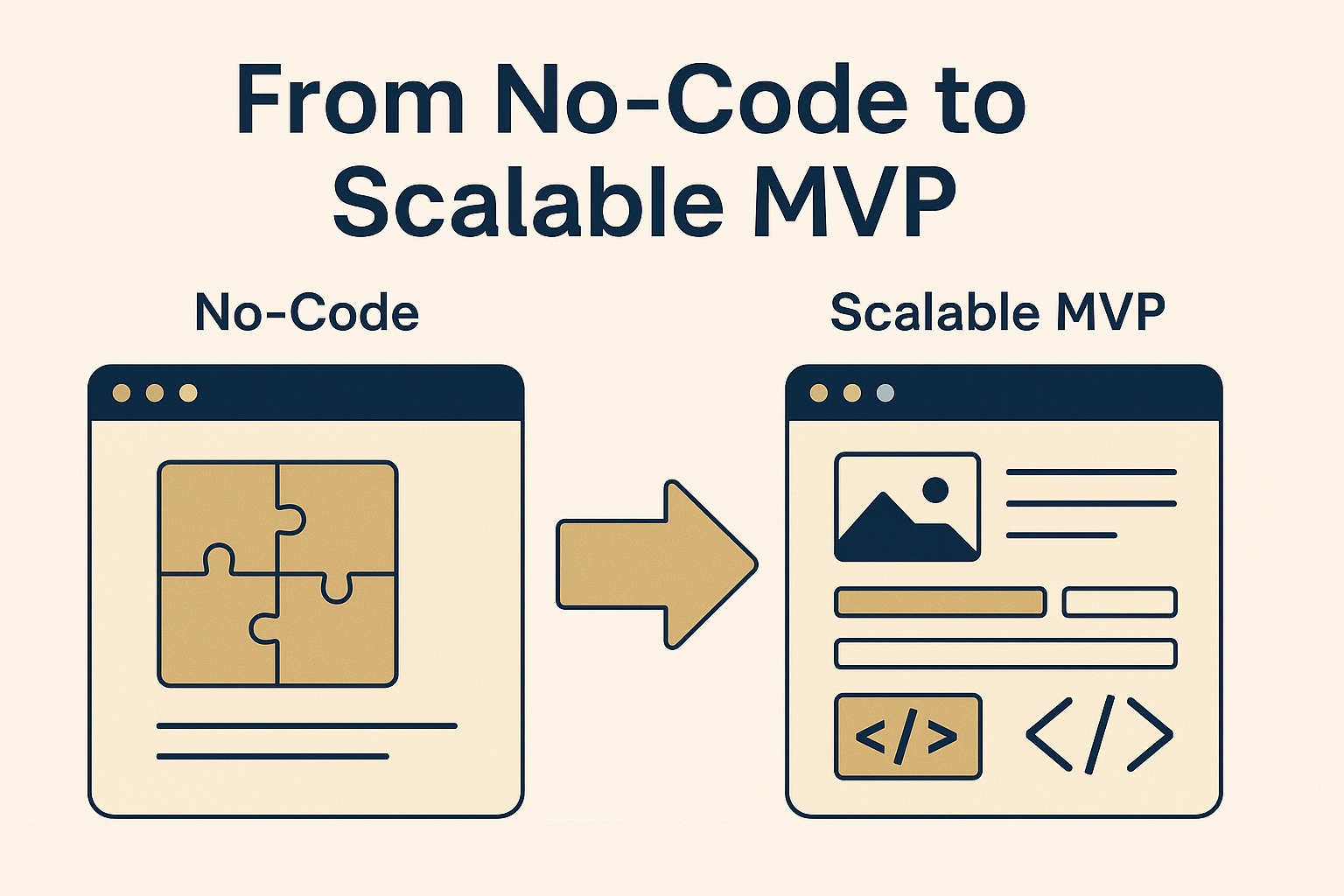
    From No-Code to Scalable MVP: When to Rebuild Your Lovable or Bubble App in Custom Code

    Over the past few years, thousands of founders have launched their first prototypes using AI no-code tools like Lovable, Bubble, Replit, FlutterFlow, and similar platforms. It’s fast, accessible, cheap and perfect for validating early ideas.

    But there’s a problem:
    no-code almost always breaks the moment you try to scale.

    At Inigra Software House, most of the founders who reach out to us have the same story:

    “We built our prototype in Bubble/Lovable, but now we can’t scale it, extend it or onboard real users.”

    This article explains exactly when a no-code app reaches its limits, what warning signs to watch for, and how to transition into a scalable, stable MVP that can grow with your users.

    Why No-Code Tools Are Perfect for Early Prototypes

    No-code platforms exploded because they remove the heavy barriers of early development.

    The advantages are undeniable:

    • You can launch in days, not months

    • You don’t need developers

    • Costs are low at the beginning

    • Perfect for MVPs, landing pages and simple dashboards

    • Great for validating demand before spending real money

    For early testing, no-code tools are excellent.
    For building a long-term product — not so much.

    Where No-Code Starts Breaking Down

    Once your app gets real usage, no-code limitations appear very quickly. These are the issues we see most often when clients come to us.

    1. Performance Issues (Slow Pages, Lags, Freezes)

    Bubble and Lovable generate a lot of hidden code and heavy workflows. As your user base grows, so does the load on the system.

    Common symptoms:

    • Pages loading in 3–8 seconds

    • Inputs freezing

    • Database searches timing out

    • Mobile version glitching

    • Workflows failing randomly

    This kills user experience immediately.

    2. High Cost of Adding New Features

    Ironically, the farther you go with no-code, the more expensive it becomes:

    • Plugins cost money

    • Advanced features require hacks

    • Workflows turn into spaghetti

    • Developers charge more because no-code is harder to extend

    At some point, rebuilding is cheaper than “patching.”

    3. Limited Flexibility and Customization

    No-code platforms limit what you can control:

    • Backend architecture

    • Database optimisation

    • Server performance

    • Security

    • Real-time features

    • Advanced automations

    • Custom integrations

    Anything beyond “simple app logic” becomes painful.

    4. Vendor Lock-In

    This is the biggest risk.

    You can’t export your code from Lovable or Bubble.
    You depend 100% on the platform.

    If the platform:

    • raises prices

    • limits features

    • changes infrastructure

    • suffers downtime

    Your product is stuck — with no escape route.

    5. Inability to Add Complex Features

    As soon as founders want anything “more advanced”, no-code hits a wall. For example:

    • Real-time notifications

    • Multi-tenant SaaS

    • Complex payment logic

    • AI features

    • Advanced dashboards

    • Messaging

    • Heavy file processing

    • Enterprise integrations

    This is the moment most founders contact a software house.

    6 Signs It’s Time to Move From No-Code to Custom Code

    After working with hundreds of prototypes, we see the same triggers over and over again.

    1) Your app slows down with real users

    If 20–50 users are enough to break performance — it’s time.

    2) Every new feature takes days or weeks

    When development starts feeling like “fighting the platform.”

    3) You hit platform limitations

    If Bubble/Lovable says: “This isn’t possible,” that’s your answer.

    4) You’re preparing to raise money

    Investors expect scalable architecture.

    5) You can’t onboard more users

    Your prototype wasn’t built for real traffic.

    6) You want to grow beyond a simple MVP

    At this stage, no-code becomes a blocker — not a tool.

    How Inigra Rebuilds No-Code Apps Into Scalable MVPs

    This is the exact process we use at Inigra Software House to transform fragile prototypes into stable, production-ready MVPs.

    Step 1 — Technical Audit

    We review everything from your no-code build:

    • screens

    • workflows

    • database

    • automations

    • API calls

    • user flows

    • bugs

    • performance

    Outcome: a clear rebuild plan with full transparency.

    Step 2 — UX/UI & Architecture Redesign

    We prepare:

    • modern UI/UX (web + mobile)

    • scalable backend architecture

    • database schema

    • development roadmap

    • complete scope

    • user stories

    You see exactly what we will build before coding starts.

    Step 3 — Full-Stack Development

    We rebuild your prototype using a tech stack designed for real scalability, such as:

    • Next.js / React

    • Node.js / NestJS

    • Flutter (mobile apps)

    • PostgreSQL / Firebase / Supabase

    • Google Cloud Platform

    The result:

    • lightning-fast performance

    • clean infrastructure

    • easy future development

    • secure code

    • no vendor lock-in

    Step 4 — QA, Testing & Launch

    We handle:

    • performance tests

    • security checks

    • automated testing

    • deployment

    • maintenance

    You receive a polished, stable, scalable MVP — ready for real users.

    How Much Does Rebuilding Cost?

    Based on our projects:

    💰 Small MVP: £5,000–£10,000

    💰 Medium MVP: £10,000–£20,000

    💰 Advanced MVP: £20,000–£30,000+

    ⏱ Typical timeline: 6–10 weeks

    Rebuilding is almost always cheaper than continuing on no-code.

    Example Scenario (Generic)

    A founder launched a Lovable prototype in 72 hours.
    Great validation.
    50 beta users joined.

    Then:

    • load times: 6 seconds

    • workflows breaking

    • database errors

    • UI not working on mobile

    • advanced features impossible

    We rebuilt the product using:

    • Next.js

    • Node.js

    • PostgreSQL

    • fully optimized UX

    In 8 weeks they had:

    • 12× faster performance

    • scalable architecture

    • clean, extendable components

    • stable backend

    • mobile-ready UI

    This is the typical transformation.

    Conclusion

    No-code is excellent for launching fast — but not for growing.
    If your product is gaining traction or running into limitations, rebuilding into custom code is the natural next step.

    This transition doesn’t have to be slow, expensive or stressful — especially with an experienced full-stack team.

    Ready to Scale Beyond No-Code?

    Book a free 30-minute Discovery Call with our CTO, Paweł Reszka.
    We’ll review your prototype and tell you exactly what it takes to rebuild it into a market-ready MVP.

    👉 Book here:
    https://calendar.app.google/EuxYZ2YtzXYMTGCq9

  • Why Your Software Project Keeps Failing Before It Starts — and What to Do Differently

    Why Your Software Project Keeps Failing Before It Starts — and What to Do Differently

    Launching a new software product is exciting. Whether it’s a mobile app, SaaS platform, or internal tool — you’re investing time, money, and energy into something that’s supposed to solve a real problem.

    But here’s the uncomfortable truth: many software projects fail before the first line of code is even written.

    Why does this happen? And more importantly — how can you avoid it?

    1. No Clear Problem = No Clear Product

    One of the biggest early mistakes is skipping the “why” and jumping straight into the “what.”

    You might know you need an app. You might even have a list of features. But without clearly identifying the problem you’re solving, everything else is guesswork.

    Tip: Spend time validating the problem with real users. Your app should be a solution to something specific — not just an idea that sounds good on paper.

    2. Starting Too Big, Too Soon

    Ambition is great. But trying to build the “final version” of your software from day one is a common trap.

    Large scope = longer development = higher costs = bigger risks.

    The smarter route? Start with an MVP (Minimum Viable Product) — a focused version of your idea that solves the core problem and allows for learning and iteration.

    MVP ≠ cheap version.
    MVP = strategic launch tool.

    3. Misalignment Between Business and Tech

    You know what your users want. Your developers know what’s technically possible. But without strong communication between those two sides, things fall apart quickly.

    Feature creep, unrealistic deadlines, and unclear goals often stem from a lack of shared understanding.

    Tip: Use discovery workshops or product sprints before development to align everyone around goals, value, and priorities.

    4. Underestimating Design and UX

    It’s easy to focus on what your app does — and forget about how it feels.

    But users don’t just need features. They need clarity, speed, and trust.

    Poor UX leads to poor retention. Inconsistent design makes your product feel unreliable. The wrong flow kills conversions.

    Tip: Treat UX/UI design as a strategic phase, not just a “nice touch.”

    5. Assuming Launch = Done

    Getting your product live is an achievement. But it’s also just the beginning.

    Successful software evolves based on user feedback, data, and market shifts. If there’s no plan for iteration, support, or growth — the product will stagnate.

    Tip: Build with scaling and maintenance in mind — not just speed.

    So What’s the Fix?

    Successful software products don’t happen by accident.

    They’re built with:

    • Strategic planning

    • Real user input

    • Agile delivery

    • Clear business goals

    • A focus on value, not just features

    Whether you’re a startup founder, product owner, or innovation lead — the challenge is the same:
    Build something people want, in a way that makes sense.

    And yes — it’s possible.

  • Why Global Companies Trust Full-Service Software Houses from Poland

    Why Global Companies Trust Full-Service Software Houses from Poland

    Outsourcing software development isn’t just about saving costs anymore—it’s about finding a tech partner you can trust. That’s why more and more companies from Germany, Australia, Singapore, Switzerland, and beyond are turning to full-service software houses in Poland.

    At Inigra, we help international clients build and scale powerful digital products—from custom web and mobile apps to enterprise AI-driven systems.

    Here’s why companies around the world choose us—and why your business might want to do the same.

    1. One Partner, All Solutions

    Choosing a full-service software house means you don’t need to juggle multiple vendors. At Inigra, we cover the entire product lifecycle, including:

    • Web and mobile app development (React, Flutter, iOS, Android)

    • Custom CRM and ERP solutions

    • AI integration and machine learning

    • UI/UX design and prototyping

    • DevOps, testing, and scaling

    • Post-launch support and feature development

    This one-stop approach ensures faster delivery, clearer communication, and better product consistency.

    2. Built for International Clients

    We work with clients from diverse regions and industries—from German logistics firms and Swiss fintechs to Australian startups and Singaporean marketplaces.

    What they all value:

    • 🕓 Time zone flexibility

    • 💬 Clear, fluent English communication

    • 📈 Business-oriented thinking (not just coding)

    • 📁 Transparent reporting and Agile workflows

    • 🤝 Long-term product partnerships

    Working with a software house in Poland like Inigra means getting a tech team that feels like part of your own.

    3. Tech-Driven, Business-Focused

    We don’t just deliver software—we help you build the right solution for your market.

    Our developers, designers, and product managers combine technical skills with a deep understanding of business strategy. We proactively suggest better approaches, flag risks early, and help optimize performance.

    Need to integrate AI? Automate workflows? Launch a scalable MVP? We’ve done it—successfully—for international brands.

    4. Proven Track Record Across Continents

    Over the past few years, we’ve delivered projects for clients in:

    • 🇦🇺 Australia – custom mobile platforms with real-time analytics

    • 🇸🇬 Singapore – e-commerce system with AI-driven recommendations

    • 🇩🇪 Germany – industrial workflow automation platform

    • 🇨🇭 Switzerland – secure finance management tools

    Our clients stay with us for years—not just one-time launches.

    5. Why Poland?

    Poland is one of the most trusted tech hubs in Europe. Ranked among the top countries for software engineering skills, it offers a unique combination of:

    • Top-tier developer talent

    • Cost-effective development rates

    • European time zone alignment

    • Strong work ethic and delivery culture

    Inigra’s headquarters in Poznań is perfectly positioned to serve both European and global markets.

    Looking for a Reliable Tech Partner?

    If you’re a startup building your first MVP or an enterprise scaling your digital systems, a Polish full-service software house can give you the strategic edge.

    ✅ From idea to launch—and beyond—we help our clients turn their ideas into world-class software.

    👉 Contact us today to tell us about your vision. We’ll help you turn it into a real, working product.

  • The Benefits of Using AI in Software Houses in Poland

    The Benefits of Using AI in Software Houses in Poland

    How Artificial Intelligence is Reshaping Software Development

    AI is transforming industries—and software development is no exception. From smart automation to predictive analytics, artificial intelligence is becoming a standard part of modern digital projects.

    At the same time, software houses in Poland are emerging as early adopters of AI-powered workflows, bringing measurable benefits to their international clients.

    In this article, we explore how AI is being used inside software houses across Poland and what value it creates for businesses.

    Why AI Matters in Today’s Software Projects

    The increasing complexity of digital platforms, user expectations, and data volume has made traditional development approaches less efficient. That’s where AI steps in.

    Key AI benefits in software development:

    • Accelerates testing and bug detection

    • Enables smart code generation and suggestions

    • Improves product recommendations and personalization

    • Automates repetitive dev-ops and QA tasks

    • Provides insights into user behavior and system performance

    For clients, this means faster delivery, higher quality, and smarter products.

    How Software Houses in Poland Are Using AI

    Poland is known for its strong technical education and engineering culture. Software houses here are now integrating AI into their everyday processes and client solutions.

    Common applications include:

    • AI-assisted development
      Using tools like GitHub Copilot or Tabnine to speed up coding with intelligent suggestions.

    • Automated testing & QA
      Machine learning models help predict bugs or test edge cases more efficiently than manual methods.

    • Natural Language Processing (NLP)
      Used in chatbots, voice interfaces, document automation, and smart search functions.

    • Predictive analytics
      For clients in e-commerce, logistics, or finance, AI is used to forecast user behavior, demand, or risk.

    • Recommendation engines
      Many Polish software houses develop AI-powered recommendation systems for SaaS, media, and marketplaces.

    At Inigra Software House, for example, we integrate AI in both the development process and client-facing features, offering smarter, more scalable solutions.

    Benefits for International Clients

    If you’re a startup, enterprise, or product team working with a software house in Poland, here’s what AI can mean for you:

    1. Faster Time-to-Market

    AI streamlines repetitive tasks like testing, data labeling, or code review—reducing development cycles.

    2. Better Product Decisions

    Machine learning models can help prioritize features based on user behavior or simulate business outcomes.

    3. Cost Savings

    With automation, fewer human resources are needed for basic testing, data analysis, or infrastructure monitoring.

    4. Competitive Advantage

    AI-enhanced apps stand out with personalized features, smarter workflows, and improved UX.

    Choosing an AI-Driven Software House in Poland

    When evaluating partners, look for companies that:

    • Have in-house AI or machine learning specialists

    • Use AI internally (e.g. in development or QA)

    • Offer data-driven services such as NLP, predictive modeling, or recommendation systems

    • Focus on business value, not just “cool tech”

    Polish software houses like Inigra combine deep technical knowledge with real-world experience in implementing AI for international clients—from Europe to the U.S.

    Let’s Build Smarter, Together

    Whether you’re looking to optimize your product with AI, or want to speed up your development cycle with automation—choosing a software house in Poland with AI capabilities is a smart move.

    ? Contact us to talk about how AI can improve your digital project. We’re here to help you innovate faster and better.

  • How to Choose the Right Software House for Your Project – A Practical Guide

    How to Choose the Right Software House for Your Project – A Practical Guide

    Choosing the right software house can make or break your digital product. Whether you’re building a mobile app, web platform, or AI-powered tool, working with the wrong team can lead to delays, scope creep, or a product that doesn’t scale.

    In this guide, we’ll break down how to evaluate and choose a software development partner that fits your business, budget, and long-term goals.

    1. Define What You Really Need

    Before contacting any software house, take time to clarify:

    • What problem are you solving?

    • Do you need an MVP or a full-featured platform?

    • Will you require long-term maintenance and scaling?

    Clear goals help you find a partner that aligns with your expectations—technically and strategically.

    2. Look Beyond the Code

    A good software house doesn’t just write code—they understand business value.

    Ask about:

    • How they approach discovery and planning

    • Their UX/UI process

    • Product management and communication style

    • Past experience in your industry or with similar business models

    At Inigra, for example, we often start with a short discovery sprint to map out key features and risks before any development begins.

    3. Evaluate Their Tech Stack and Scalability

    Choose a software house that works with modern, scalable technologies like:

    • React, Flutter, Node.js, PostgreSQL

    • Cloud platforms like AWS or GCP

    • DevOps practices (CI/CD, containerization)

    But more important than stack is their ability to adapt to your current or future infrastructure.

    4. Review Case Studies and Testimonials

    Look at their real work:

    • Did they build something similar to what you need?

    • Do they have case studies or client interviews?

    • What industries do they specialize in?

    Here at Inigra, we’ve built everything from AI-enhanced mobile apps to unattended retail platforms. Explore our portfolio.

    5. Consider Culture Fit and Communication

    Especially if you’re outsourcing, cultural alignment and communication rhythms are crucial. Look for teams who:

    • Are fluent in English

    • Offer transparent project updates

    • Use tools like Slack, Jira, Figma, GitHub

    • Are responsive and available across time zones

    Working with a software house in Poland like ours means nearshore convenience for European companies—and partial time overlap for US-based clients.

    6. Understand Their Process (and How You’ll Be Involved)

    Ask about:

    • Agile or Scrum frameworks

    • Sprint planning, demos, retrospectives

    • Testing and QA approach

    • Code review and documentation standards

    Pro tip: Always choose a team that involves you in the process—not just sends you updates.

    7. Think Long-Term: Support, Maintenance, Scaling

    After launch, your product will evolve. The right software house will offer:

    • Ongoing support & bug fixing

    • Performance optimization

    • Feature iteration

    • Roadmap planning

    At Inigra, we often act as long-term product partners—not just a delivery team.

    Final Thoughts – Don’t Just Hire a Team. Choose a Partner.

    The best software house is one that treats your product like their own. They think ahead, communicate openly, and push for quality at every stage.

    If you’re looking for a trusted tech partner to build or scale your digital product—let’s talk.

    ? Contact us today to discuss your goals and get honest feedback before you commit.

  • What to Expect When Working with a Software House in Poland – Process, Tools, Culture

    What to Expect When Working with a Software House in Poland – Process, Tools, Culture

    Choosing a software house in Poland is not just about outsourcing—it’s about building a true partnership. Beyond the technical skills and competitive pricing, Polish software teams are known for their structured processes, communication standards, and problem-solving culture.

    In this article, we’ll walk you through what it’s like to work with a Polish development team—from the first discovery call to product launch and long-term support.

    1. Discovery Phase – They Start by Asking “Why?”

    One of the first things you’ll notice when working with a software house in Poland is that teams don’t just ask what you want to build—they focus on why.

    Polish developers and project managers prioritize business context, which often leads to better product decisions early in the process.

    ✅ You can expect:

    • A structured kick-off meeting

    • Product discovery workshops

    • User journey mapping

    • Early risk and feasibility assessment

    2. Agile Development Process with Transparency

    Most Polish software houses follow Agile or Scrum methodologies. This means you’re part of the process—not just waiting for a finished product to arrive.

    Weekly sprints typically include:

    • Sprint planning

    • Daily standups (if needed)

    • Demo calls at the end of each sprint

    • Feedback loops and iteration planning

    Tools commonly used:

    • Jira, Trello – for task and sprint management

    • Slack, MS Teams – for daily communication

    • Notion, Confluence – for documentation

    • Figma – for UX/UI design collaboration

    You get full transparency into progress, blockers, and resource planning.

    3. Tech-Driven, but Business-Focused

    Yes, you’ll work with great engineers. But Polish software houses also understand product-market fit and user experience.

    Expect your developers to:

    • Recommend better technical approaches

    • Think long-term about scalability

    • Flag unnecessary features

    • Ask about your KPIs and goals

    This mindset makes them true tech partners, not just code vendors.

    4. Cultural Fit & Communication

    You’ll find that teams from Poland are highly aligned with Western business culture:

    • Direct, honest feedback

    • Clear documentation

    • Punctual meetings

    • High English proficiency

    • Proactive attitude

    Working across time zones? Most teams adjust their schedules to match your working hours (especially for clients in Europe and North America).

    5. Post-Launch Support & Iteration

    Polish software houses often offer post-launch support, SLA maintenance, and continuous development. That means your product won’t be left unsupported after release.

    Typical support may include:

    • Bug fixing and performance monitoring

    • Feature iteration and roadmap development

    • Security updates and code refactoring

    • Analytics implementation and reporting

    Why Inigra?

    At Inigra Software House, we don’t just write code—we help you build the right product. Our team in Poznań works closely with clients to understand business goals, map user needs, and deliver long-term value.

    We combine:

    • Senior-level developers and product designers

    • Clear communication and documentation

    • Flexible cooperation models (project-based, dedicated team)

    • Focus on performance, scalability, and UX

    Let’s Build It Right

    If you’re looking for a dependable, forward-thinking software house in Poland, you’re in the right place.

    ? Contact us today and tell us what you want to build—we’ll help you turn your vision into a working solution. Our portfolio. 

  • How AI-Powered Automation Is Changing the Way Businesses Operate

    How AI-Powered Automation Is Changing the Way Businesses Operate

    Artificial Intelligence is no longer a futuristic concept—it’s a core part of how modern businesses optimize workflows, reduce operational costs, and stay ahead of the competition. Whether you’re a startup or an established enterprise, AI-powered automation can dramatically improve efficiency and scalability across departments.

    Why AI-Powered Automation Matters Right Now

    The past two years have seen a major acceleration in AI adoption across industries. Tools like ChatGPT, Midjourney, and GitHub Copilot have made AI tangible and accessible. But beyond consumer-facing tools, custom AI development is where companies are truly unlocking long-term value.

    Key benefits of business automation using AI:

    • Faster and more accurate data processing

    • Reduced human error and operational costs

    • Predictive analytics for smarter decision-making

    • 24/7 task execution without fatigue

    • Enhanced customer experience through chatbots and personalization

    According to McKinsey, 70% of businesses will adopt at least one form of AI by 2030. Companies that embrace AI now will build a major competitive edge.

    What Can Be Automated with AI?

    From finance and logistics to customer support and marketing—AI offers automation opportunities across departments.

    Popular AI use cases include:

    • Invoice processing using Optical Character Recognition (OCR) + machine learning

    • Chatbots and virtual assistants powered by NLP (Natural Language Processing)

    • Predictive maintenance in manufacturing

    • Smart email routing in customer service

    • Sales forecasting with AI-driven data models

    • Fraud detection in fintech apps

    The potential is vast. But for automation to be truly effective, it must be customized to your workflows and data ecosystem—and that’s where a dedicated AI development team comes in.

    Why Work with a Software House for AI Projects?

    While off-the-shelf tools have their place, businesses looking for scalable, integrated solutions need a custom AI strategy. A software house offers:

    • Cross-functional teams (AI engineers, data scientists, developers)

    • End-to-end service: from business analysis to deployment

    • Experience in integrating AI with existing ERP, CRM, or custom platforms

    • Emphasis on data security, model explainability, and GDPR compliance

    At Inigra Software House, we help companies build tailored AI solutions—from smart automation engines to predictive dashboards and machine learning APIs.

    Getting Started with AI for Your Business

    Implementing AI doesn’t have to mean building a neural network from scratch. Most successful projects start small—with a single process or workflow—and scale from there.

    Our typical process:

    1. Discovery – we analyze where AI can bring the most value

    2. Prototype – rapid development of a small-scale solution

    3. Integration – connect AI with your existing systems

    4. Optimization – tune performance, accuracy, and scalability

    Ready to Automate Smarter?

    If you’re exploring how AI can streamline your operations or want to develop a custom solution for your business, we’re here to help.

    ? Contact us here and let’s discuss your AI goals.

    Whether it’s a smart assistant, predictive tool, or full automation platform—Inigra Software House can deliver AI that works for your business.

  • Why Working with a Software House in Poznań Might Be the Best Decision You’ll Make

    Why Working with a Software House in Poznań Might Be the Best Decision You’ll Make

    What Makes a Software House Stand Out in 2024?

    In a world full of IT service providers, the term software house is often thrown around—but not all software houses are created equal. The best ones combine technical excellence, business insight, and human-centered design. But there’s something unique happening in Poznań, Poland—and it’s not just pierogi or medieval cathedrals.

    Poznań has become one of the fastest-growing tech hubs in Central Europe. With a rich academic tradition, thriving startup scene, and highly skilled talent pool, software houses based here are delivering world-class solutions for global clients—at costs that won’t give your CFO a heart attack.

    At Inigra Software House, we’re proud to be part of this vibrant tech ecosystem, helping companies from around the world bring their digital visions to life.

    Poznań: Where Tradition Meets Technology

    Here’s a fun fact: Poznań is home to one of the oldest universities in Poland, but also one of the youngest tech scenes. The Adam Mickiewicz University (AMU) has long produced top-tier engineers, mathematicians, and computer scientists. Many of them now work in agile teams, building complex custom software for industries like fintech, healthtech, and e-commerce.

    While Silicon Valley startups race for talent, Poznań offers something rare—quality, stability, and innovation in one place.

    ? Did you know? Poznań was one of the first Polish cities to introduce municipal Wi-Fi zones back in the early 2000s—proof that digital thinking runs deep here.

    What a Software House Actually Does – And Why You Need One

    Let’s break it down. A software house is a company that provides end-to-end development services. Unlike freelancers or temporary contractors, a software house offers a full-cycle development team under one roof:

    • Business analysts

    • UX/UI designers

    • Front-end and back-end developers

    • QA testers

    • Project managers

    • AI and cloud specialists

    That means no guesswork, no handover chaos, and no lost emails between outsourced departments.

    Key Services You Can Expect

    Working with a top-tier software house in Poznań typically includes:

    ✅ Custom Software Development

    Tailored solutions for your business needs, from scratch. Whether it’s ERP systems, SaaS platforms, or internal automation tools.

    ✅ Mobile & Web Applications

    Cross-platform mobile apps or responsive web interfaces that delight users across devices.

    ✅ System Integrations

    Connect your CRM, e-commerce, or legacy systems into one seamless digital environment.

    ✅ AI & Machine Learning Solutions

    From fraud detection to natural language processing—software houses here know how to make data work smarter.

    ? Polish engineers consistently rank among the top 3 globally in algorithmic problem-solving (HackerRank).

    Collaboration That Feels Local (Even If You Aren’t)

    Despite being in Poland, Poznań-based software houses are fluent in English, agile in communication, and transparent in process. Most teams work with:

    • Slack / MS Teams for daily syncs

    • Jira / Trello for task management

    • GitHub / Bitbucket for clean, collaborative code

    Timezone differences? Minimal. In fact, Poznań’s location offers overlapping working hours with clients across Europe, the UK, and even the U.S. East Coast.

    Why Global Companies Are Choosing Poznań

    Here’s the secret sauce: Poznań combines the engineering depth of Berlin, the affordability of Eastern Europe, and the service culture of the Nordics.

    Clients from the UK, Germany, the Netherlands, and the U.S. are increasingly turning to software houses in Poznań for:

    • Faster time-to-market

    • Long-term technical partnerships

    • Cultural compatibility and ease of doing business

    ? Unlike “one-and-done” dev shops, many Poznań software houses focus on long-term relationships and product scalability.

    Ready to Build Something Together?

    If you’re searching for a trusted software house to turn your idea into reality, we’re here to help. At Inigra, we combine strategic thinking with technical expertise to deliver solutions that perform—and scale.

    Whether you’re building your MVP, digitizing your internal processes, or launching a full-scale SaaS platform—let’s talk. We’ll listen, advise, and help you move forward with clarity and confidence.

    ? Contact us today to start your project with a team that cares as much about your success as you do.

  • Mobile App Success Starts with UX/UI – How a Software House Can Make or Break Your Product

    Mobile App Success Starts with UX/UI – How a Software House Can Make or Break Your Product

    Why UX/UI Design is Crucial for Mobile App Development

    In the saturated world of mobile apps, success isn’t just about writing clean code. It’s about delivering a user experience (UX) and user interface (UI) that people love to use. A sleek, intuitive, and functional design is often what separates a top-performing app from one that gets deleted after the first use.

    If you’re planning to build a mobile app, collaborating with an experienced software house that understands the synergy between UX/UI and development can dramatically improve your chances of success. Contact us.

    What Is UX/UI and Why Does It Matter?

    UX (User Experience) refers to how users interact with your app – how intuitive, seamless, and satisfying that interaction is.
    UI (User Interface) focuses on the look and feel – colors, typography, buttons, and layout.

    Together, UX/UI design determines whether users will:

    • Understand how to use your app instantly,

    • Find it visually appealing and trustworthy,

    • Return to it regularly or abandon it forever.

    Poor design decisions can lead to:

    • Low retention,

    • High uninstall rates,

    • Negative reviews in app stores.

    Role of a Software House in Delivering Outstanding UX/UI

    Working with a full-cycle software house, like Inigra Software House gives you access to a team of professionals who understand both the design and technical aspects of app development. Here’s how they typically approach UX/UI for mobile apps:

    1. Discovery & Research

    Before a single line of code is written, a good software house starts by:

    • Researching the target audience,

    • Analyzing competitor apps,

    • Defining user personas and user journeys.

    ? Goal: Ensure the design solves real problems and delivers business value.

    2. UX Wireframes & Information Architecture

    The design team maps out how users will move through your app. They create wireframes that outline navigation, screen flows, and content layout.

    ? A clean UX structure helps reduce development rework and usability issues later.

    3. UI Prototypes and Design Systems

    Next, the UI designers build interactive prototypes that bring the visual side of the app to life. They define a design system that ensures consistency across every screen – fonts, buttons, icons, and color schemes.

    ✨ A well-designed UI not only builds trust but also reflects your brand identity.

    4. Collaboration Between Designers and Developers

    A huge benefit of working with a software house is the tight integration between design and development teams. Designers understand what’s feasible technically, and developers know how to implement design without compromising performance.

    ⚙️ They use tools like Figma, Zeplin, and Storybook to sync design with front-end implementation.

    How UX/UI Impacts App Store Rankings and ROI

    Many businesses underestimate how much UX/UI affects their bottom line and app store visibility.

    • App Store Optimization (ASO): Positive reviews often mention how “easy to use” or “intuitive” the app is – key signs of good UX.

    • User retention: A pleasant first-time user experience leads to higher session times and more active users.

    • Monetization: UX/UI affects conversion rates for in-app purchases, subscriptions, or lead generation.

    ? Well-designed mobile apps simply make more money and grow faster.

    Why Work with a Software House Instead of Freelancers or In-House Teams?

    Choosing a software house over freelancers or hiring in-house has several advantages, especially when it comes to end-to-end product quality.

    Expertise Across the Full Stack

    • UX strategists

    • UI designers

    • Mobile developers (iOS/Android/Flutter)

    • QA engineers

    • Product owners

    This cross-functional collaboration ensures your mobile app doesn’t just look good – it performs, scales, and aligns with your business goals.

    Proven Process & Delivery

    Software houses typically work in Agile or Scrum frameworks. They’ve launched dozens (sometimes hundreds) of apps and have refined their process to avoid the common pitfalls.

    Scalability & Support

    As your app grows, a software house can support additional features, handle backend integrations, and help with cloud deployment or analytics.

    ? Bonus: They often bring business insights from working with multiple industries (fintech, health, e-commerce, etc.).

    Real-World Use Case

    Let’s say you’re launching a fitness app that needs:

    • Personalized workouts,

    • Video instructions,

    • Push notifications,

    • In-app subscriptions.

    A software house can handle:

    • UX research to understand fitness users’ pain points,

    • UI design that makes daily use feel like a breeze,

    • Scalable back-end for user data,

    • Native or cross-platform development with fast performance.

    They’ll also help with app store submission, ongoing updates, and post-launch analytics.

    Summary – UX/UI is Your Mobile App’s First Impression. Make It Count.

    Investing in professional UX/UI design is not a “nice to have” – it’s a core component of building a successful mobile app. When you work with a seasoned software house, you’re not just getting code – you’re getting:

    • Strategic UX planning,

    • Intuitive UI execution,

    • Seamless handoff to development,

    • A scalable product ready for the market.

    Whether you’re building your first MVP or revamping an existing app, prioritize UX/UI from day one and choose a partner who knows how to translate vision into results. Contact us.