Short answer: AI-powered software development means experienced engineers building your product with AI tools handling the repetitive work - so you get the same production-grade result in a fraction of the time, and for less money. The key word is powered, not replaced: a human still designs the architecture, reviews every line, and owns the outcome. Here's what it actually means, why it's faster and cheaper, and where it does - and doesn't - help.
What is AI-powered software development?
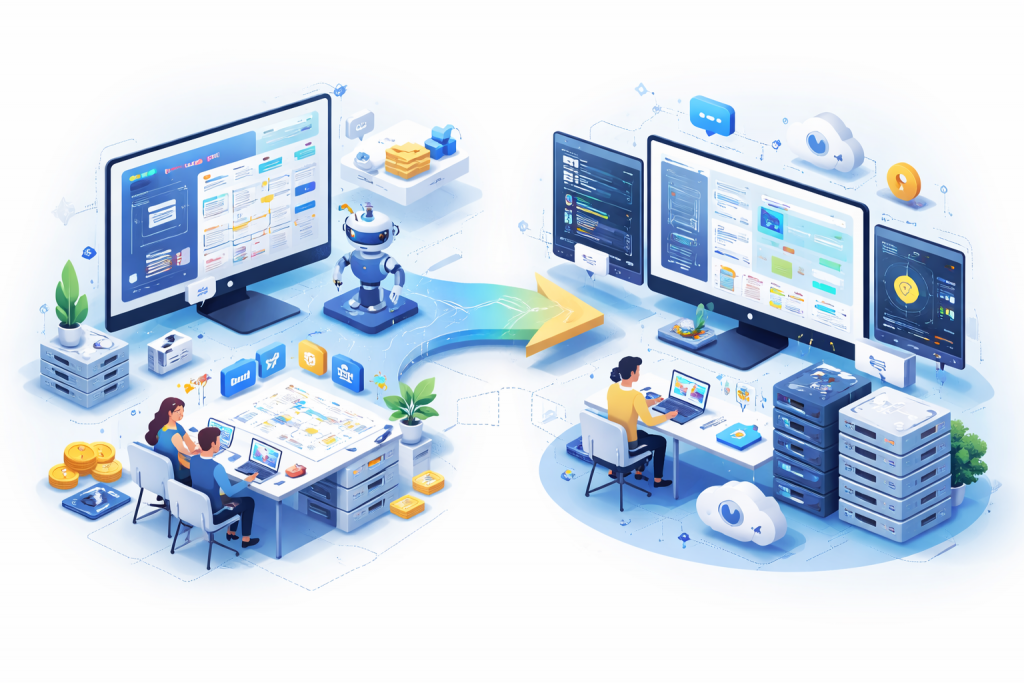
AI-powered software development is a way of building software where engineers use AI - code assistants, code generation, automated testing - to move faster, while humans stay in charge of the design, the decisions and the quality. The AI accelerates the work; it doesn't run unsupervised.
That distinction matters, because "AI wrote some code" can mean two very different things:
- AI-powered development (human in the loop): an engineer uses AI to draft and speed up code, then reviews, tests and hardens it. You get production-grade software, faster.
- "Vibe coding" (no human review): you describe what you want to an AI and ship whatever it produces without reading it. Great for a quick prototype, risky once real users arrive. (We wrote about why vibe-coded apps break at scale separately.)
Done properly, AI-powered development is the first one: human expertise, accelerated by AI.
How does it actually work?
The simplest way to think about it is a clear division of labour between the engineer and the AI:
| The engineer does | The AI accelerates |
|---|---|
| Architecture and technical decisions | Boilerplate and repetitive code |
| Security, data and access design | First-draft implementations |
| Code review and testing | Test scaffolding and documentation |
| Owning the result end to end | The slow, mechanical parts |
The AI removes the hours that used to go into typing out the obvious parts. The human keeps doing the part that actually needs judgement - which is exactly why the quality holds up.
We build web, mobile and SaaS products with AI-accelerated engineers - fixed price, code you own.
Why is it faster?
Because a large share of software work is not the clever part - it is repetition. Setting up projects, wiring up standard features, writing tests, re-typing patterns you've built a hundred times. AI handles that work in seconds instead of hours, so on many tasks an AI-accelerated engineer builds several times faster than they used to.
In practice that's the difference between a first working version in weeks instead of months. The thinking still takes real time; the mechanical typing mostly disappears.
Why is it cheaper - for you?
Software cost is mostly engineering time. Cut the time, and the cost follows:
- You stop paying for boilerplate. The hours that used to go into repetitive code are gone, so you're paying for outcomes, not typing.
- Fixed price becomes realistic. Faster, more predictable builds make fixed-scope, fixed-price projects far easier to quote honestly.
- You reach revenue sooner. Shipping in weeks means your product can start earning - or start being validated - months earlier.
Same quality, less time, lower bill. That is the whole point.
Does the quality suffer if AI writes the code?
This is the fear, and it's fair - but the answer is no, as long as a human reviews what the AI produces. Unreviewed AI code is where apps get into trouble: exposed secrets, missing access controls, no tests, architecture that falls over under load. That's not a property of AI - it's a property of shipping code nobody checked.
AI-powered development keeps the human checks that make software safe: real architecture, proper authentication and data handling, tests, and an engineer who actually understands how it all fits together. You get the speed of AI with the accountability of a person.
What can you build this way?
Most things, honestly - the approach is a way of working, not a product category:
- MVPs and new products - validate an idea in weeks, not quarters.
- New features for an existing app, without the usual backlog crawl.
- Integrations - CRMs, payments, analytics, third-party APIs.
- Modernizing old software - replacing a legacy system one process at a time, instead of a big, risky rewrite.
- Internal tools and AI IT automation - automating the slow, manual processes your team does by hand.
What about "AI IT automation"?
It's a close cousin. AI IT automation means using AI to take over repetitive internal work - processing data, routing requests, generating reports, connecting systems that don't talk to each other. The rule we follow is simple: automate the step only where it removes real, repeated work. If AI genuinely saves your team hours, we build it in; if it's AI for the sake of looking modern, we leave it out. The measure is whether it removes work, not whether it sounds impressive.
AI-powered vs the old way
| The old way | AI-powered development |
|---|---|
| Months to a first version | Weeks to a first version |
| Paying for every hour of boilerplate | Paying for outcomes |
| Big, hard-to-quote projects | Faster, fixed-price scopes |
| Slow to validate or earn | In market sooner |
Is it right for your project?
It's a strong fit when you want to move quickly without gambling on quality: a new MVP, a product that needs to ship and start earning, a legacy system you want modernized without a year-long rewrite, or internal work that's begging to be automated. If your project is genuinely novel research or extremely regulated, you'll still lean more on human hours - but even then, AI removes the busywork around the edges.
The bottom line
AI-powered software development isn't about replacing engineers - it's about giving experienced ones a faster way to work. The AI handles the repetitive parts; the human handles the parts that decide whether your software is secure, scalable and truly yours. The result you should expect: production-grade software, shipped in weeks not months, at a lower cost - and full ownership of everything built.
Frequently asked questions
What is AI-powered software development?
It's building software with experienced engineers who use AI tools - code assistants, generation, automated testing - to do the repetitive work faster, while humans handle architecture, review, security and ownership. The AI is powered by a person, not left to run alone, so you get a production-grade result in less time.
Is AI-powered development actually cheaper?
Usually, yes. Software cost is mostly engineering time, and AI removes the hours that went into repetitive code and setup. Less time means a lower bill, and it makes honest fixed-price quotes far more realistic. You pay for outcomes, not for typing out boilerplate.
Is the quality lower if AI writes the code?
Not when a human reviews it. Problems come from shipping unreviewed AI code - exposed secrets, missing access controls, no tests. AI-powered development keeps the human checks: real architecture, proper security, tests, and an engineer who understands the whole system. Speed from AI, accountability from a person.
Who owns the code?
You do - all of it. AI-powered development produces a normal, production codebase in your repositories and accounts. There's no lock-in and no "the AI owns it" catch. It's your asset, ready to hand off or continue with anyone.
Can AI replace software developers?
No - it replaces the repetitive parts of their work, not the judgement. Someone still has to design the system, decide the trade-offs, review the code and take responsibility for it. AI makes a good engineer faster; it doesn't remove the need for one.
Is AI-powered development good for MVPs?
It's one of the best fits. An MVP is about validating an idea quickly, and AI-accelerated engineering gets you a real, working first version in weeks - so you can put it in front of users or investors months earlier, without shipping something fragile.